 By
The first time you step into the torii tunnels at Fushimi Inari Taisha, something strange happens. The noise of the crowd behind you fades, the light turns orange, and all you hear is gravel under your shoes. Gate after gate after gate, climbing up a forested mountain in Kyoto. I kept thinking the tunnel would end around the next bend, and it just kept going.
It was the No. 1 spot in my top 10 places to visit in Japan, and it is a highlight of my 10-day Japan luxury rail and ryokan itinerary. But this post is only about the shrine itself: the legend behind it, why the gates are orange, what the foxes are holding, and how to enjoy the mountain without fighting the crowd. So here is everything you need to know about Fushimi Inari Taisha.
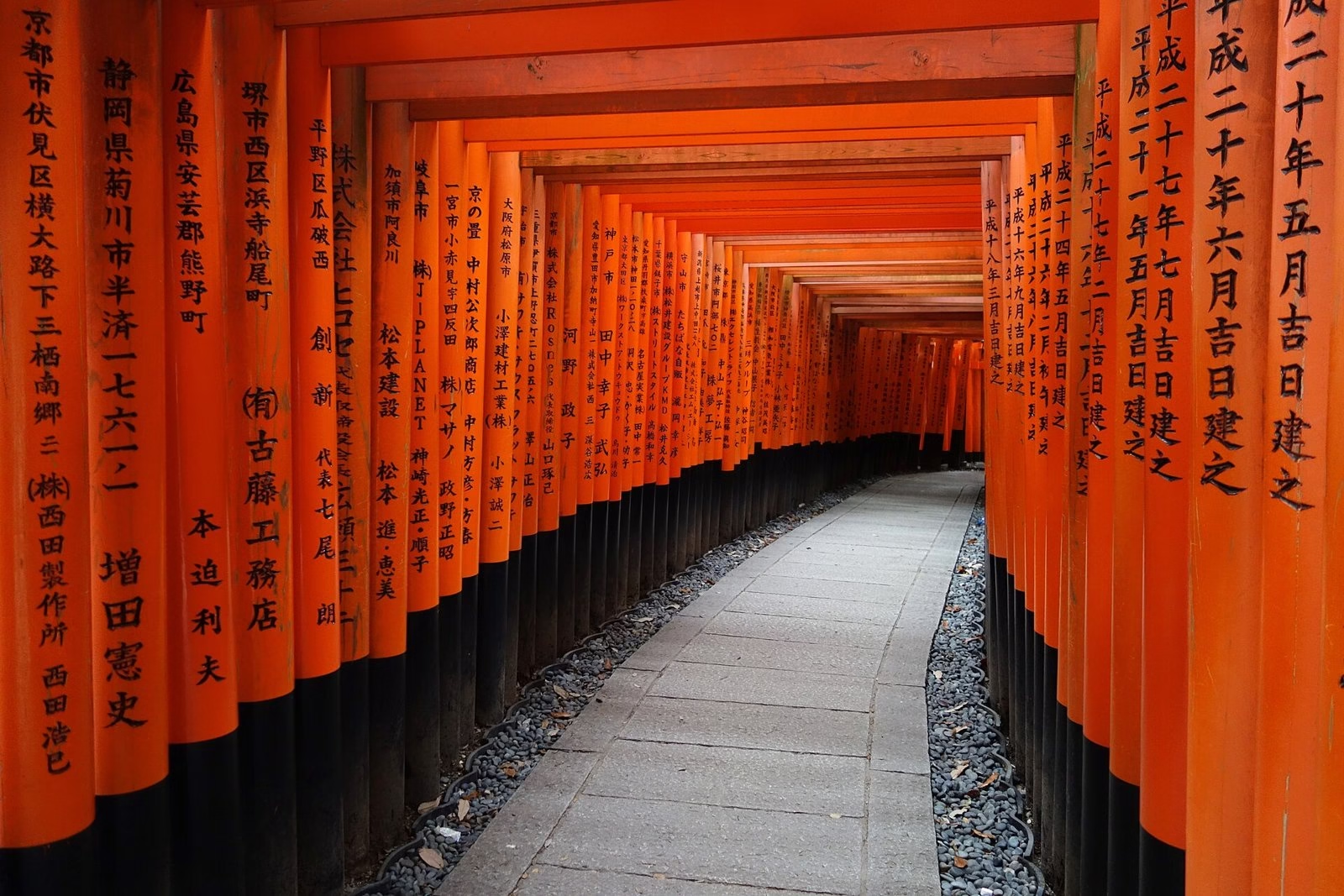
Photo: Luka Peternel, Wikimedia Commons, CC BY-SA 4.0. Original composition; resized for web.
Fushimi Inari Taisha: what it actually is
Fushimi Inari Taisha is the head shrine of Inari, the Shinto god of rice, harvest and prosperity, in the Fushimi area of southern Kyoto. There are said to be around 30,000 Inari shrines across Japan, and this is the one at the top of all of them. The shrine buildings sit at the foot of Mount Inari, a 233-metre hill, and the whole mountain is treated as sacred, with trails of torii running all over it.
Inari started as a god of rice, but over the centuries merchants adopted it as their god of business success. That is why so many of the gates you walk through were donated by companies, from small family shops to big corporations, all hoping for a good year. It is also one of the busiest shrines in Japan for hatsumode, the first shrine visit of the New Year, when millions of people come in the first days of January.
The legend of the rice cake and the white bird
The shrine traces its roots to 711, when it was set up on the three peaks of Mount Inari. The story is linked to the Hata clan, a powerful family in the Kyoto area. According to an old legend, a wealthy man of the clan named Hata no Irogu was so rich that he used a round rice cake as an archery target. When his arrow hit it, the rice cake turned into a white bird and flew off to the mountain, and rice sprouted where it landed.
The name is said to come from that moment: ine nari, rice grows, which over time became Inari. I love that a shrine visited by millions today began with a story about a man being a little too careless with his food, and the gods giving him a lesson.
The Romon Gate and the main hall
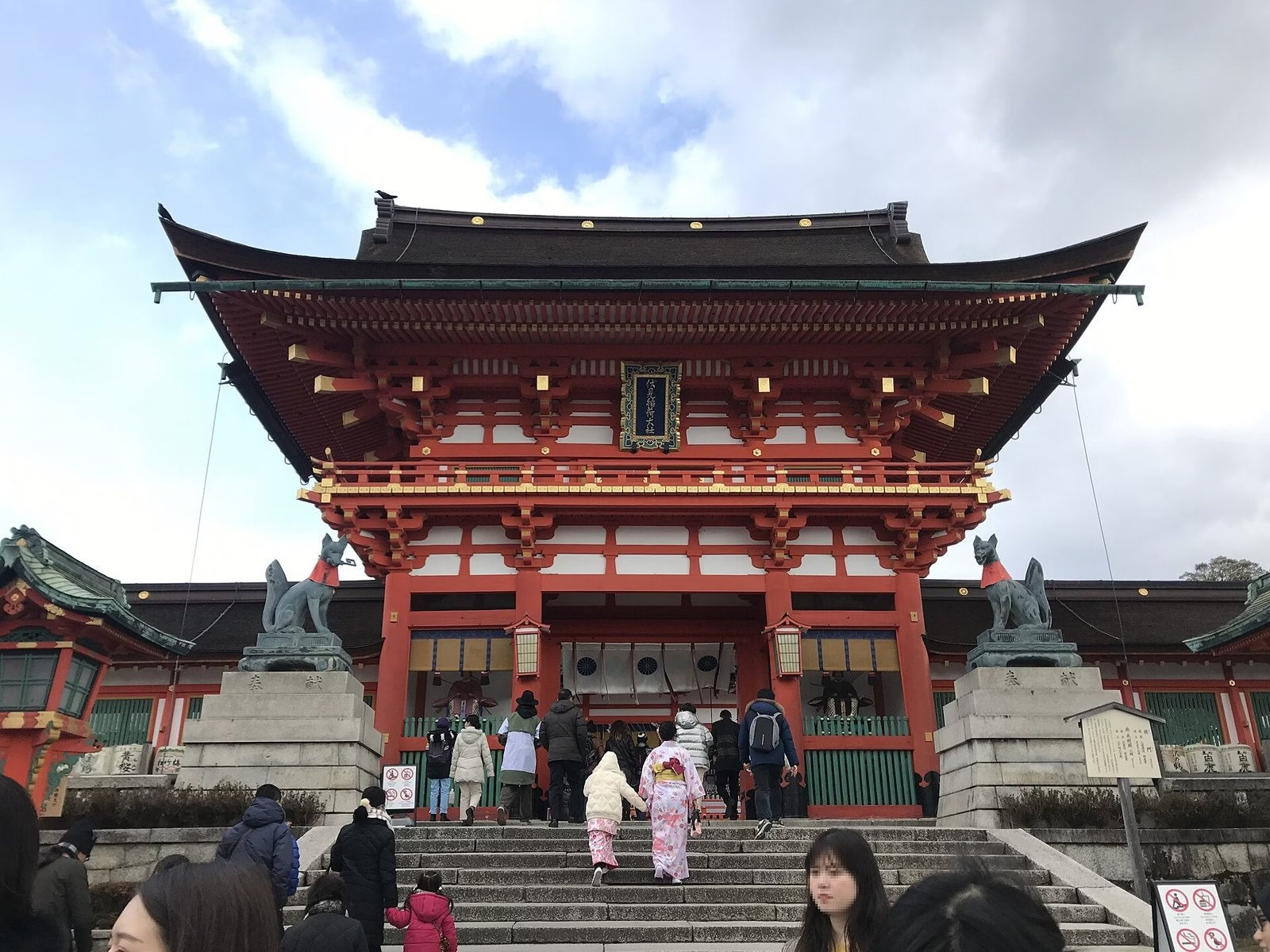
Photo: Soramimi, Wikimedia Commons, CC BY-SA 4.0. Original composition; resized for web.
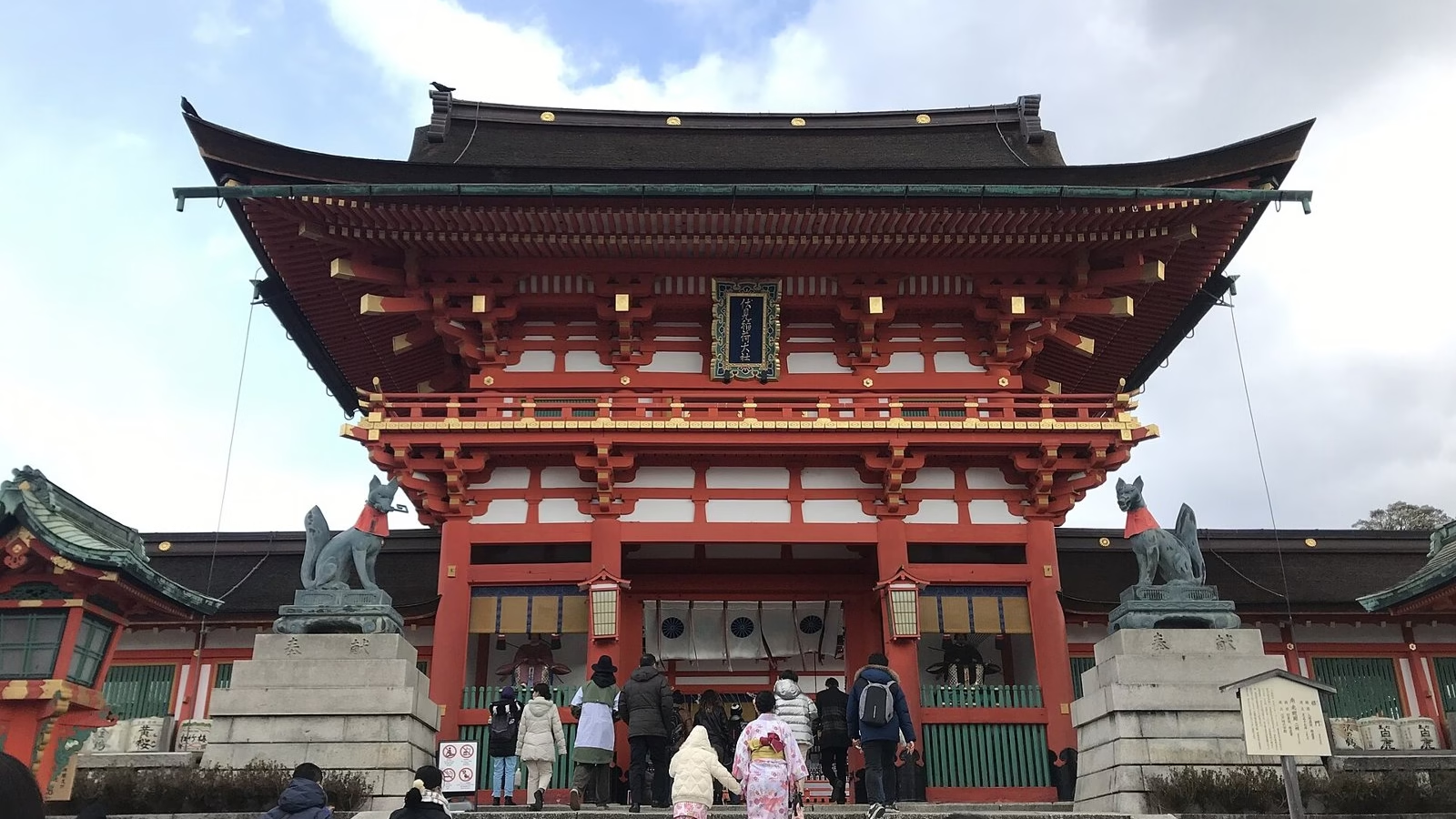
Your visit starts with the big Romon Gate, the two-storey tower gate at the top of the entrance steps. It is traditionally said to have been donated in 1589 by Toyotomi Hideyoshi, the warlord who unified Japan, as thanks after his mother recovered from an illness. Look at the two stone foxes guarding it on either side; they are your first hint of what is coming up the mountain.
Behind it stands the honden, the main hall. The shrine was burnt down in 1468 during the Onin War, the civil war that wrecked much of Kyoto, and the present main hall was rebuilt in 1499. It is listed as an Important Cultural Property of Japan. Notice the long, flowing front roof that sweeps down over the steps where people pray, a classic style of old Shinto architecture.
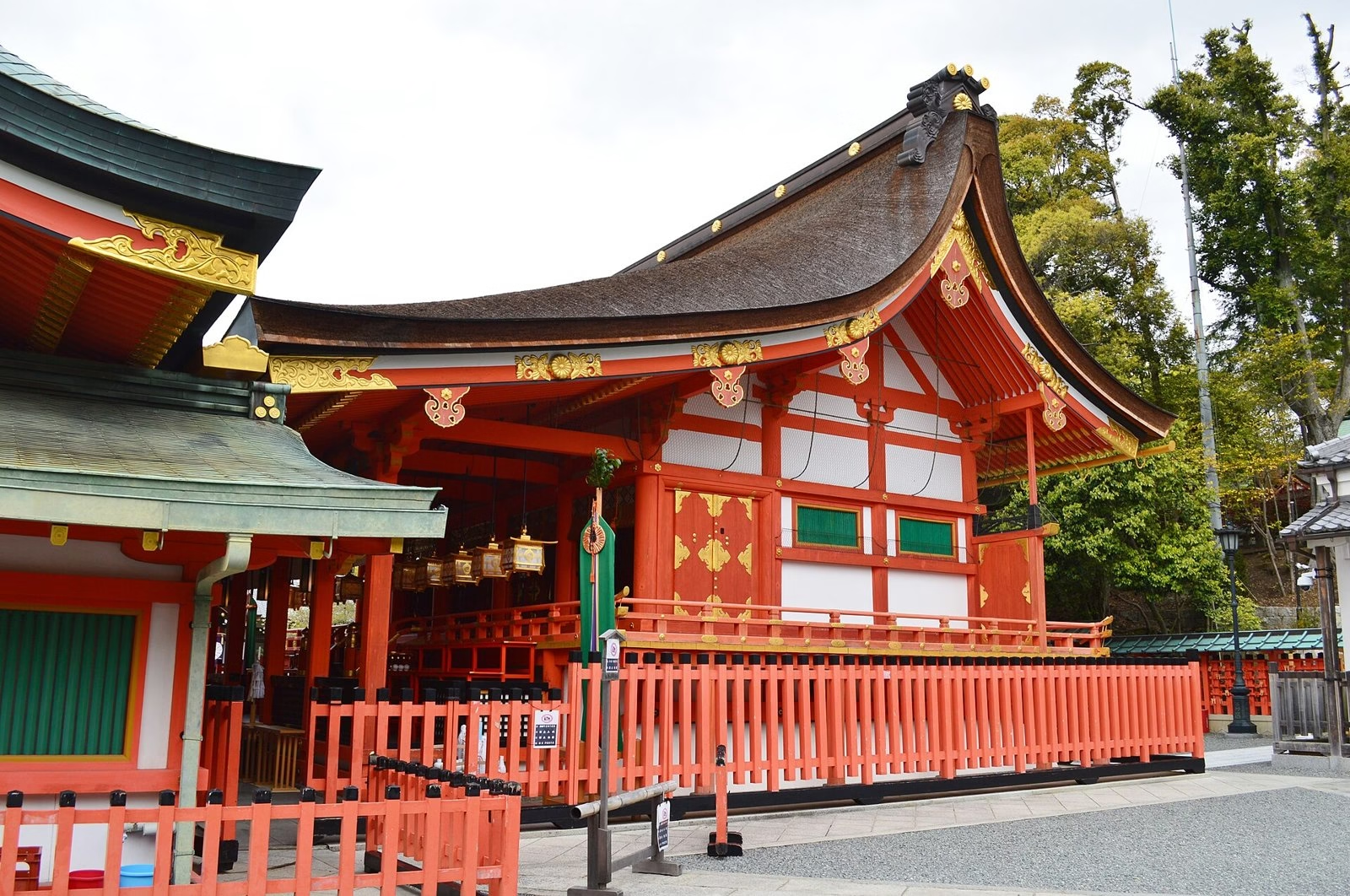
Photo: Saigen Jiro, Wikimedia Commons, CC0. Original composition; resized for web.
Senbon Torii: walking through a thousand gates
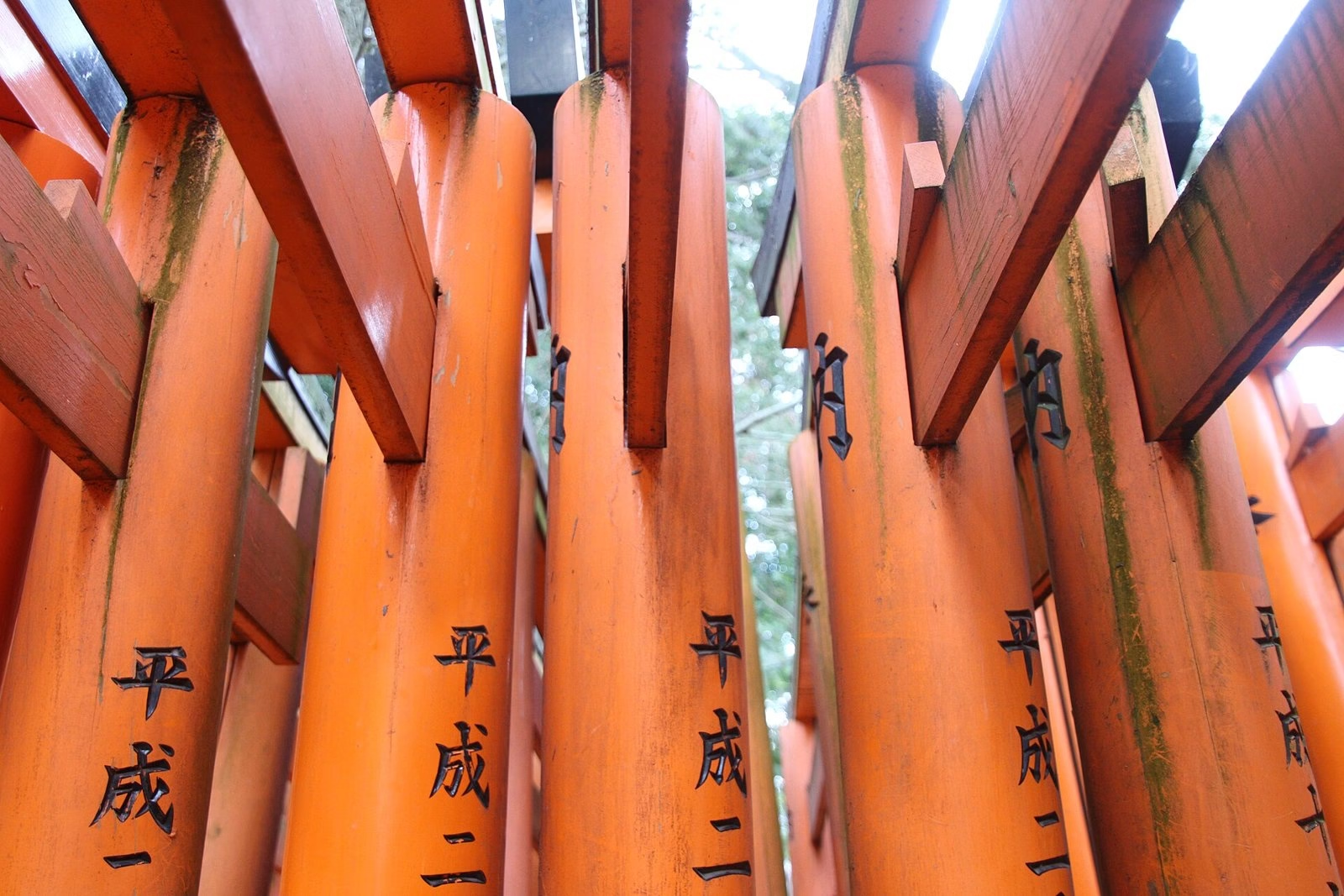
Photo: Hyppolyte de Saint-Rambert, Wikimedia Commons, CC BY-SA 4.0. Original composition; resized for web.
Just behind the main buildings, the path splits into two narrow, parallel tunnels of torii packed so close together that they almost touch. This stretch is called Senbon Torii, which means a thousand torii, and it is the scene you have seen on every postcard. It even appears in the 2005 film Memoirs of a Geisha, where young Chiyo runs through the gates.
Here is the detail most people miss: walk up, then turn around. On the way up you mostly see plain orange. On the way back you see the black writing on every pillar, which is the name of the person or company who donated that torii and the date it was offered. The thousand is not a real count either. Across the whole mountain there are thought to be around 10,000 torii, and new ones keep replacing the old, weathered ones.
Why every gate is bright orange
The colour is called shu, a vermilion orange, and you will see it on Inari shrines all over Japan. It is believed to ward off evil and to stand for life and energy. There is a practical side too: the traditional pigment was made from cinnabar, which contains mercury and helped protect the wood from rot and insects. The bottom of each pillar is painted black, which makes the orange glow even more in photos, especially in soft morning light.
Foxes with keys in their mouths
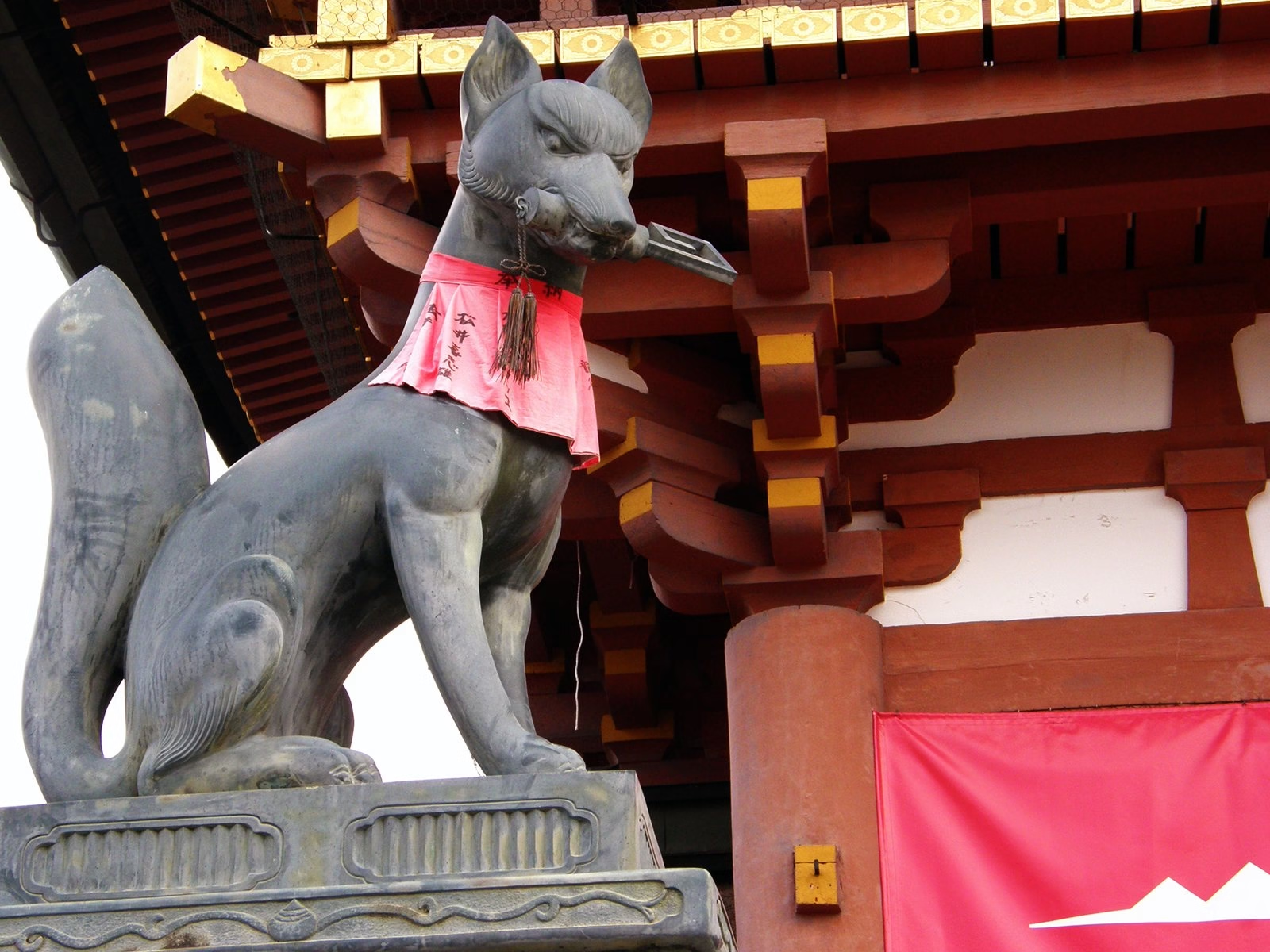
Photo: Tomi Makitalo, Wikimedia Commons, CC BY-SA 3.0. Original composition; resized for web.
Once you start looking, you will see foxes everywhere at Fushimi Inari: stone foxes at the gates, foxes on the altars and tiny fox figures tucked into little shrines on the mountain. In Japanese they are called kitsune, and they are believed to be the messengers of Inari, not the god itself.
Look at what each one holds in its mouth. The most common is a key, which is said to be the key to the rice granary. Others hold a jewel, a sheaf of rice or a scroll. Many wear red bibs offered by worshippers. Foxes are also said to love fried tofu, and that little belief has given Japan two famous dishes, which I will come to below.
Fox-face ema: the wishes people leave behind
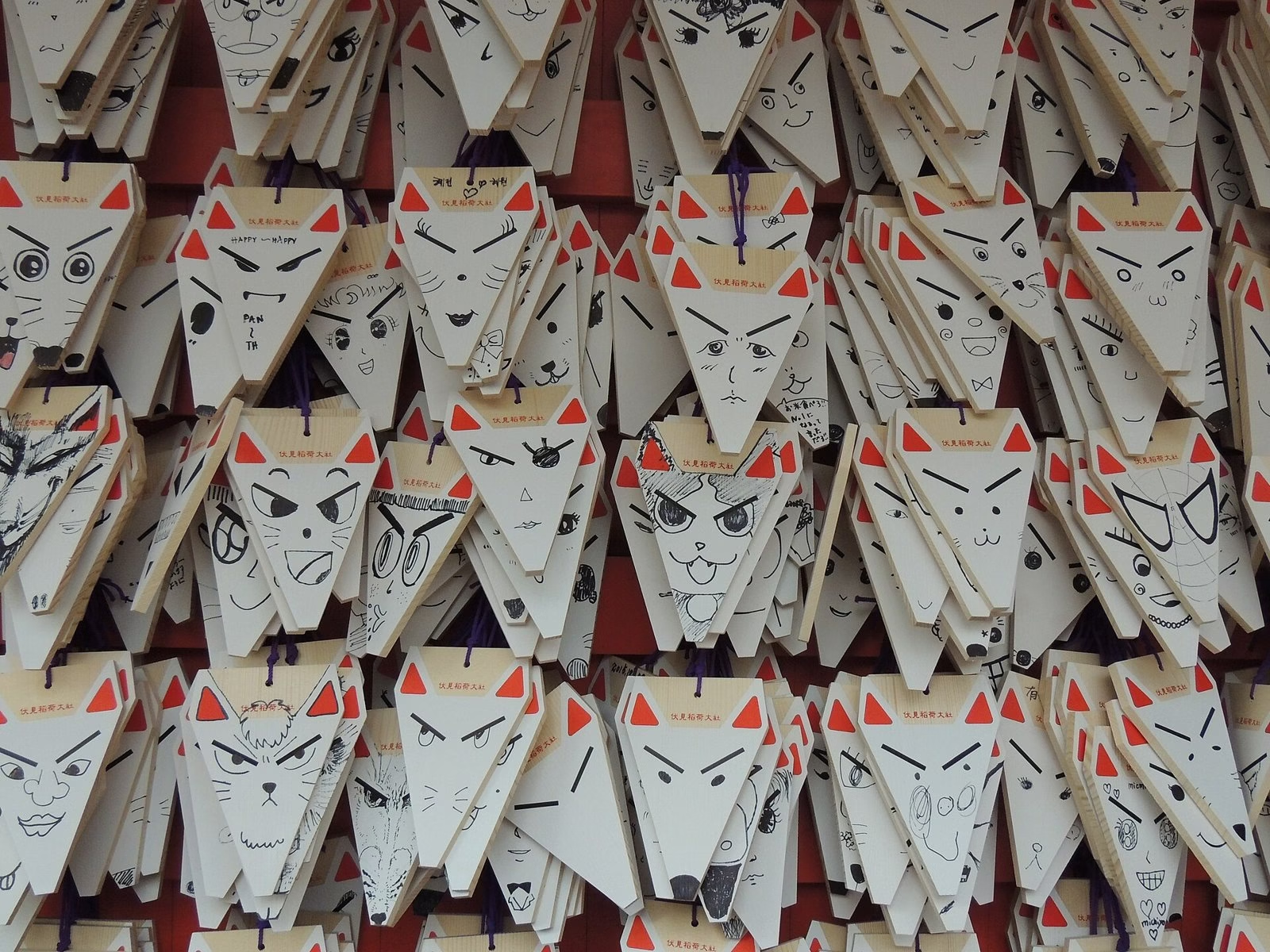
Photo: Madame Tatillonne, Wikimedia Commons, CC BY-SA 4.0. Original composition; resized for web.
Ema are small wooden plaques on which people write wishes and hang them at a shrine. At most shrines they are rectangular, but at Fushimi Inari they are shaped like a fox face, and people draw in the eyes and expressions themselves. Some foxes are cute, some are angry, some look like anime characters. Spend two minutes reading the racks; it is one of the most fun little corners of the shrine.
Omokaru-ishi: the heavy-light stone
At the end of the Senbon Torii you reach the Okusha Hohaisho, the inner prayer hall, and next to it are a pair of stone lanterns with round stones on top. These are the Omokaru-ishi, the heavy-light stones. The idea is simple: make a wish, then lift the stone. If it feels lighter than you expected, your wish is likely to come true. If it feels heavier, you may have to work harder for it. Lift gently with both hands and put it back carefully.
Climbing Mount Inari: stone mounds, Yotsutsuji and the summit
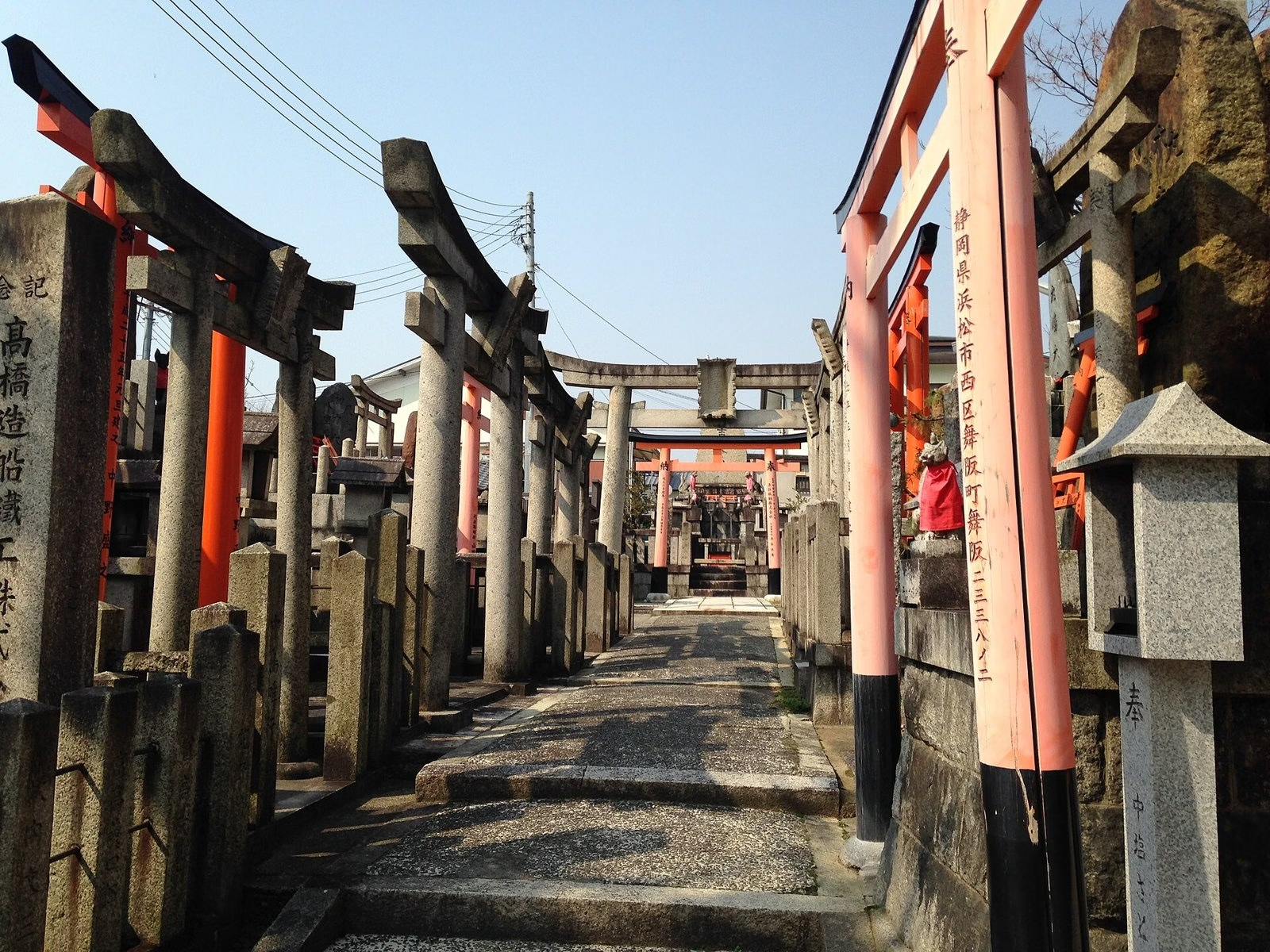
Photo: Soramimi, Wikimedia Commons, CC BY-SA 3.0. Original composition; resized for web.
Most visitors turn back after the Senbon Torii and the heavy-light stones, and honestly that is where the real magic starts. As you climb higher, the gates get a little more spaced out, the crowd thins and you begin to see otsuka, stone mounds and small altars set up by worshippers, crowded with miniature torii, fox statues and offerings. Some corners feel like a little village of shrines hidden in the forest.
About halfway up you reach Yotsutsuji, a crossing where the trail splits, with an open view over Kyoto. This is the best place to stop, catch your breath and watch the city spread out below, especially around sunset. From here the trail loops around to Ichinomine, the summit, and back. The full climb to the top and down usually takes 2 to 3 hours with stops, and it is steady stairs most of the way, so go only as far as your legs are happy.
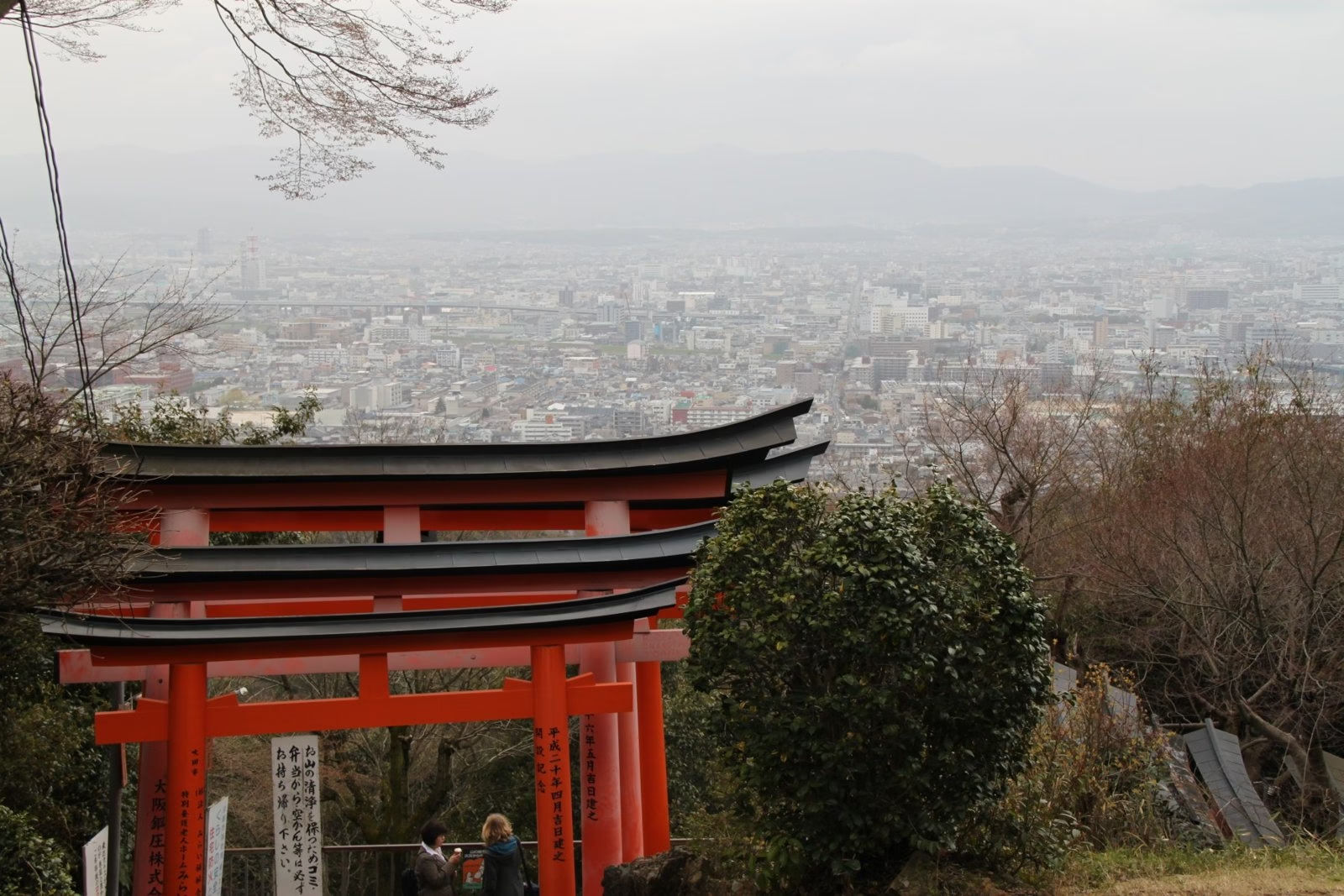
Photo: dres2222, Wikimedia Commons, CC BY-SA 3.0. Original composition; resized for web.
One thing that surprised me: there is no grand view from the very summit, because it is covered in trees. So if you only have energy for part of the climb, Yotsutsuji is the smart place to turn around. To get the location of the shrine, click here.
What to eat around the shrine
The lane leading to the shrine is lined with small eateries and street-food stalls. Two things are a must here because of the fox and its love for fried tofu, and both are named after Inari and its messengers. Inari sushi is sushi rice stuffed into a sweet, slightly juicy pouch of fried tofu, and kitsune udon is thick udon noodles in hot broth topped with a big slice of sweet fried tofu. Kitsune literally means fox. Both look vegetarian, but the tofu and the broth are often cooked with dashi, a fish stock, so ask first if you are strict vegetarian. You will also find grilled skewers, sweets and fox-shaped crackers to take back home.
Shrine manners and practical tips
- Entry to Fushimi Inari Taisha is free, and the grounds and mountain trails are open all day and night, so early morning and evening visits are possible.
- Wear proper walking shoes. The steps are uneven stone and get slippery after rain.
- Carry water, especially in summer. There are small shops and vending machines on the lower and middle parts of the trail, but you are better off having your own bottle.
- Bow once before passing through the main torii, and walk along the sides of the path, because the centre is believed to be the way of the god.
- At the purification basin, rinse your left hand, then your right, then pour a little water into your cupped left hand to rinse your mouth. Never drink straight from the ladle.
- Do not lean on, hang from or write on the torii, and do not block the narrow tunnels for long photo shoots. Step aside and let people pass.
- Some halls and inner areas do not allow photography, so look for the signs.
Best time to visit Fushimi Inari Taisha
Fushimi Inari is beautiful all year, but timing in the day matters more than the season. Early morning, soon after sunrise, the tunnels are quiet and the light glows through the gates. Mid-day is very crowded, and late evening is atmospheric, with lamps lit along parts of the trail, though the upper mountain gets very dark, so carry a light. For seasons, spring and autumn are the most pleasant for the climb. Kyoto’s autumn colours are usually best from mid-November to early December, the rainy season usually runs through June and July, and summer is hot and humid with mosquitoes on the forest trails. Avoid the first days of January unless you want to see the New Year crowds.
FAQ
- Is Fushimi Inari Taisha free to visit?
Yes. There is no entry fee for Fushimi Inari Taisha, and the grounds and the Mount Inari trails are open around the clock. Things like ema plaques, charms and fortunes are paid offerings.
- How long does it take to climb Mount Inari?
The full climb to the summit and back usually takes 2 to 3 hours with stops. If you go only up to the Yotsutsuji viewpoint about halfway up and come back, it takes much less.
- How many torii gates are there at Fushimi Inari?
The famous stretch is called Senbon Torii, or a thousand torii, but across the whole mountain there are thought to be around 10,000 torii, each donated by a person or a company.
- Why are there fox statues at Fushimi Inari?
Foxes, or kitsune, are believed to be the messengers of Inari, the god of rice and prosperity. Many of the statues hold a key in their mouths, said to be the key to the rice granary.
- What is the best time to visit Fushimi Inari Taisha?
Early morning is the best time, when the torii tunnels are quiet and the light is soft. Evenings are atmospheric too, while mid-day is usually very crowded.
Final Thoughts
Fushimi Inari Taisha is one of those rare famous places that is actually better than its photos. Go early, walk past the point where everyone turns back, lift the heavy-light stone and read a few fox ema on the way down. Would you climb all the way to the summit or stop at Yotsutsuji with the view? Tell me in the comments. For the rest of Japan, read my top 10 places to visit in Japan. And if old sacred places are your thing, see my Shore Temple Mahabalipuram guide, or if you want sea and cliffs, my Capri day trip guide. Travelling alone? My solo travel in India guide is a good start.
Fushimi Inari is part of my 10-day Japan luxury rail and ryokan itinerary, along with Tokyo, Hakone, Kyoto and Okinawa. You can just use it for the number of days you have, book from its links and go, with no planning worries. If you want a custom version for your own dates, CLICK HERE to start on the trip form.
I plan the route. I don’t book the ferry, the stay, or the tickets. A custom plan is Rs. 200 per travel day. Fill the trip form, pay online, and I’ll send you the plan.