 By
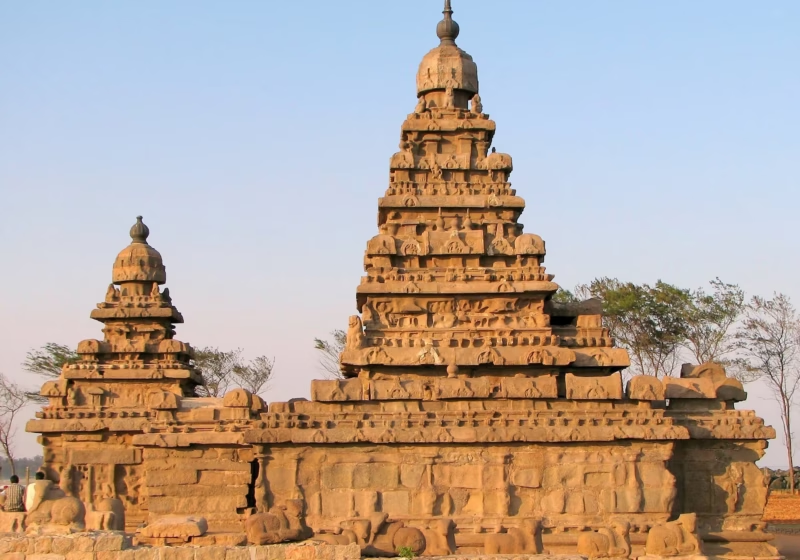
Shore Temple Mahabalipuram is one of those places where the setting does half the talking. Two granite towers rise beside the Bay of Bengal in Tamil Nadu, and the stone looks nothing like a freshly painted temple in the middle of a busy town. It is weathered, open to the sky and full of small details that are easy to miss if you only come away with the usual front-facing photo.
If you enjoy history but do not want a history lecture, this is the kind of monument I would suggest looking at slowly. The wider coastal trip is in my Pondicherry, Auroville and Mahabalipuram itinerary; here, let us stay with the temple itself, the stories around it and what makes this patch of coastline so special.
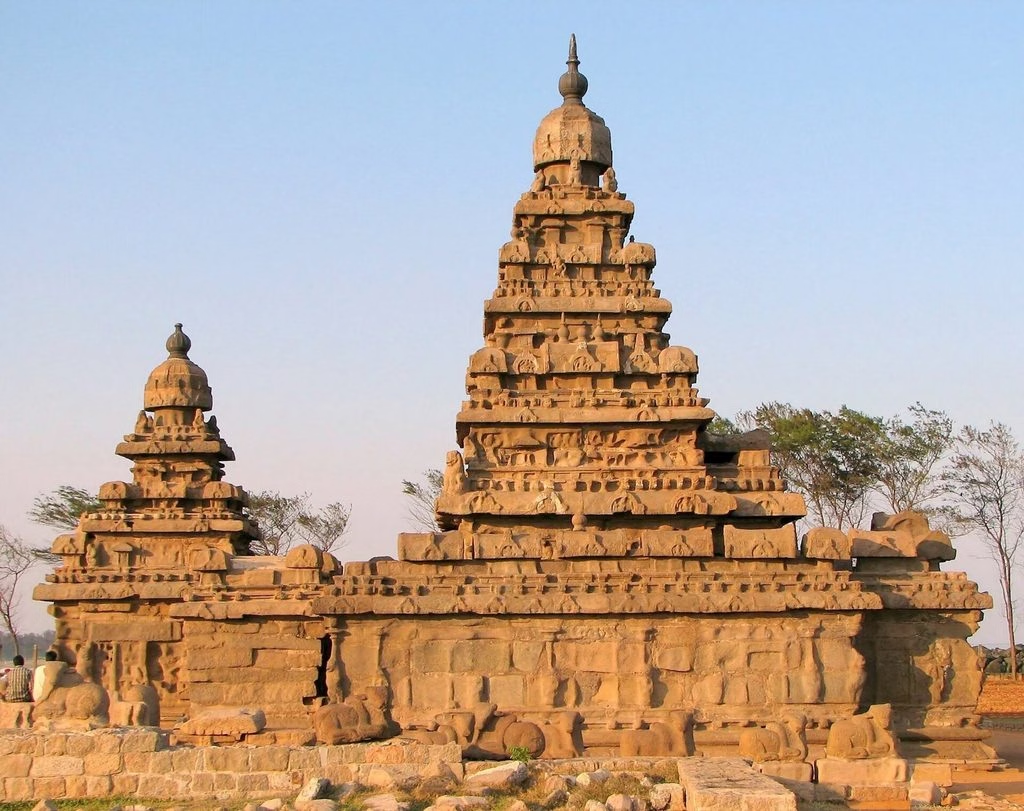
Photo: Bernard Gagnon, Wikimedia Commons, CC BY-SA 3.0. Original composition; resized for web.
Shore Temple Mahabalipuram: the history behind the skyline
The Pallavas built more than a pretty skyline

Photo: Manoj M Shenoy, Wikimedia Commons, CC BY-SA 4.0. Original composition; resized for web.
The Shore Temple belongs to the early 8th century and the reign of the Pallava king Narasimhavarman II, also called Rajasimha. Mamallapuram, another name for Mahabalipuram, was an important Pallava port. So the sea beside the temple is not just a lovely background; it belongs to the story of a town connected to the world beyond its shore.
What makes this temple important is how it was built. Many of the famous monuments around Mahabalipuram were cut into living rock or carved from huge boulders, while the Shore Temple was assembled from granite blocks. It is among the earliest surviving structural stone temples in South India, and that difference is worth keeping in mind when you look at its walls.
The temple is part of the Group of Monuments at Mahabalipuram, inscribed on the UNESCO World Heritage List in 1984. That recognition covers a whole family of Pallava creations, not only this seaside landmark. The interesting part is seeing how many different things the craftsmen could persuade stone to become.
What to notice at the Shore Temple?
Read the towers, not just the signboard
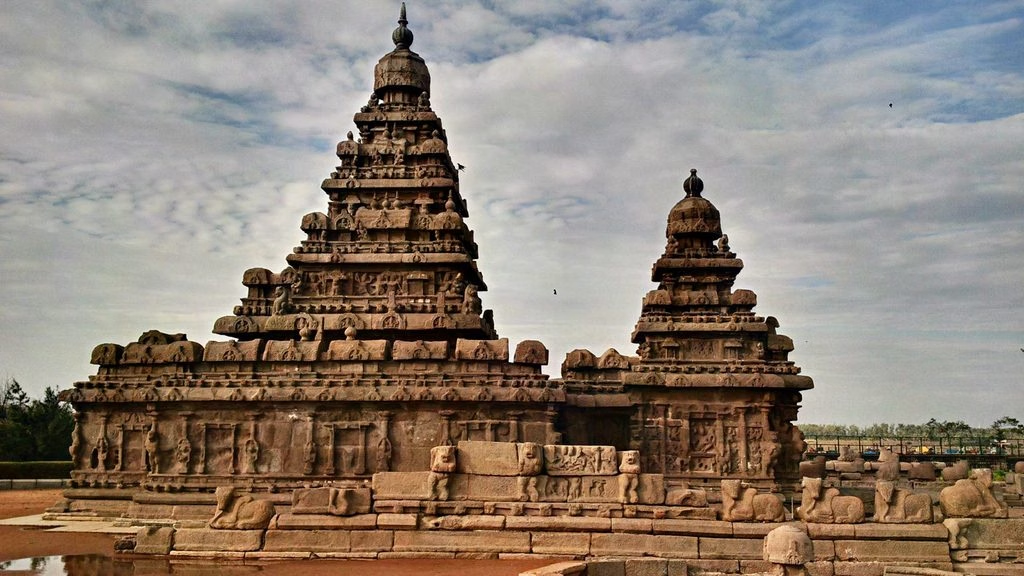
Photo: C.S.Gautham, Wikimedia Commons, CC BY-SA 4.0. Original composition; resized for web.
The stepped, pyramidal towers are the first thing your eyes will follow. Each level pulls the shape inward until it reaches the rounded crown, so even from a distance the outline feels very deliberate. You do not need to know the names of every architectural part to enjoy it; just look at how the repeated ledges create shadow across the granite.
There are three shrines in the complex, with two dedicated to Shiva and one to a reclining Vishnu. The two prominent towers can make you assume there are only two sanctuaries, which is why the smaller elements deserve attention too. It is a compact complex with more going on than its postcard silhouette suggests.
I would suggest comparing the broad outline with the close-up details. From farther back, the towers look sharp and orderly, but nearer the stone you see softened edges and worn carvings. The sea-facing setting that makes the monument beautiful has also been hard on its decoration.
Meet the Nandis around the enclosure
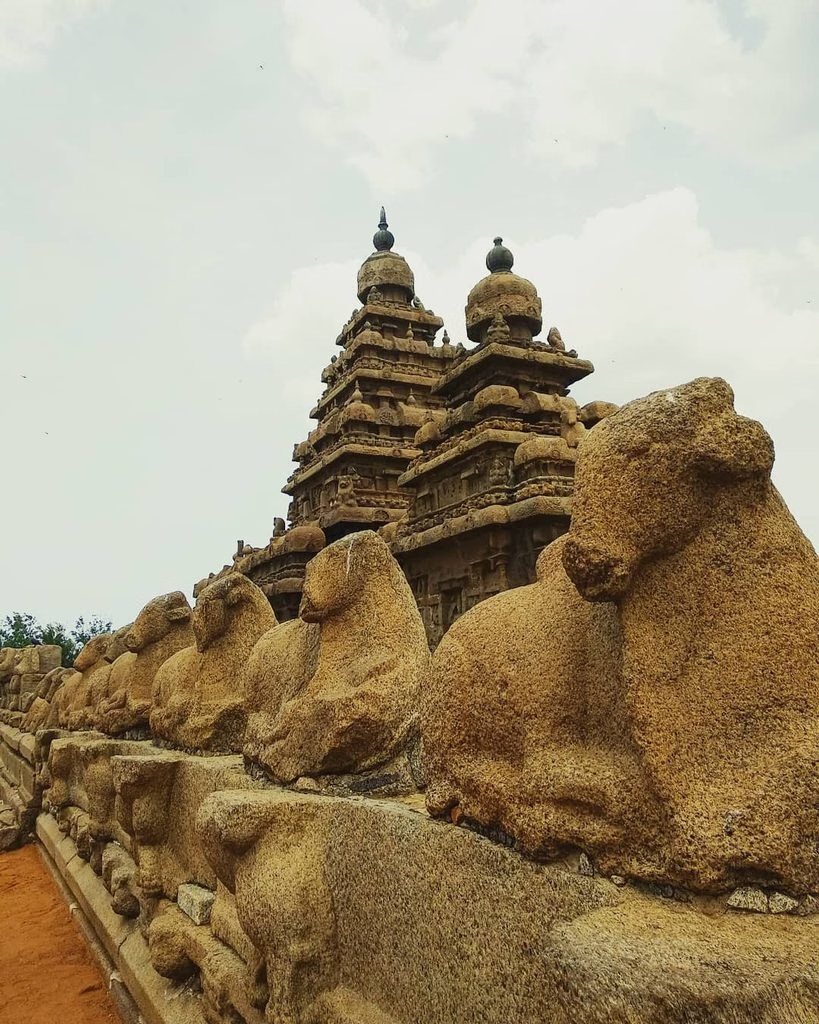
Photo: Tridib Ray, Wikimedia Commons, CC BY-SA 4.0. Original composition; resized for web.
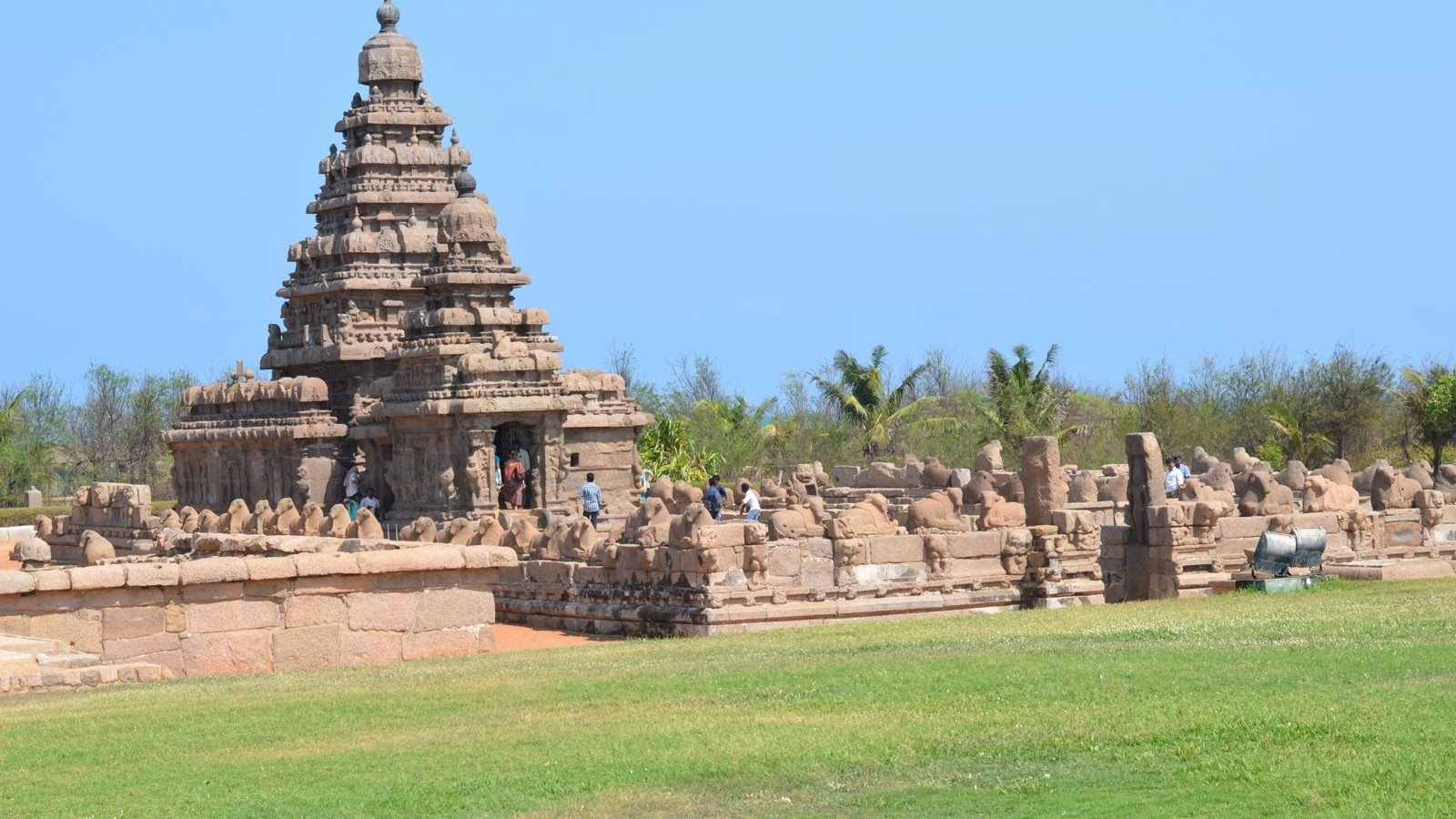
The seated stone bulls around the enclosure are Nandis, associated with Shiva. Their repeating forms give the temple a second rhythm below the towers, and they make a photograph feel much more rooted in the place than a frame of sky and roof alone. Some look so rounded by weathering that you notice their posture before you notice their faces.
These are the details I would pay attention to rather than rushing to collect another identical wide shot. Look at the texture and the different surviving shapes, but do it from the permitted visitor areas. A sculpture that has lasted this long does not need us climbing on it for a better camera angle.
The Seven Pagodas: a good story, not a proven headcount
Mahabalipuram is closely associated with the story of the Seven Pagodas. In the familiar version, seven temples stood along this coast and the sea swallowed six, leaving the Shore Temple behind. With the Bay of Bengal right there, you can understand why a story like that stays in the imagination.
But a legend and an archaeological conclusion are not the same thing. Buried structures have been found around the Shore Temple, and research into the coastal remains adds to the history of the area. That does not mean we should confidently describe six complete matching temples waiting underwater. Enjoy the mystery without turning it into a fact that the evidence has not settled.
What the place feels like
The appeal here is the contrast: heavy stone and moving air, small carved details and a very large sky. Unlike a monument squeezed between buildings, the Shore Temple has room around its outline. Even a simple view across the grounds makes the towers feel connected to the coast rather than cut off from it.
Do not expect every sculpture to look crisp or every photograph to be free of people. The worn surfaces are part of the character, and other visitors are part of the experience too. For me, the better way to enjoy a place like this is to stop treating age as damage that needs hiding and start noticing what has survived.
Photo tips without turning the place into a studio

Photo: Vyacheslav Argenberg, Wikimedia Commons, CC BY 4.0. Original composition; resized for web.
Start with a frame that leaves breathing space around the towers. If the topmost finial is almost touching the edge of your screen, pull the composition back a little. Keep vertical lines as straight as possible, because pointing a wide-angle phone camera sharply upwards can make the temple look as if it is leaning away from you.
For another view, use the Nandi row as a foreground from a permitted position and let the towers sit behind it. A closer photograph of stone texture can tell a different story from the wide view. Softer light helps bring out the carving, while strong overhead light can flatten it, so look at where the shadows fall rather than relying on a filter to rescue everything.
A person in the frame can show the scale beautifully, but ask before making a stranger the subject of your photo. Keep paths clear while you compose, and do not cross a barrier because the angle looks cleaner on the other side. The best picture is not worth being that person everyone else has to walk around.
The other monuments help the story make sense

Photo: Vyacheslav Argenberg, Wikimedia Commons, CC BY 4.0. Original composition; resized for web.
The Pancha Rathas show another side of Pallava craftsmanship: temple forms carved from individual boulders rather than assembled from blocks. The different roof shapes make a nice comparison with the Shore Temple towers. Their name means five chariots, but these are stone architectural forms, not vehicles that once rolled through the town.
Then there is the great open-air relief commonly called Arjuna’s Penance or the Descent of the Ganges. Its crowded world of figures and animals offers a completely different way of telling a sacred story in stone. The two names reflect different interpretations of its subject, so there is more to look at than a single neat label.
The Varaha cave sanctuary adds the experience of sculpture within a rock-cut space. Together, these monuments show why Mahabalipuram matters: caves, monoliths, reliefs and structural temples all belong to the same larger artistic landscape. For the wider mix of places, my Top 10 places in Pondicherry, Auroville and Mahabalipuram gives you the broader picture without turning this temple story into a checklist.
Final Thoughts
If you like places where the landscape is as memorable as the monument, the Shore Temple makes a strong case for Mahabalipuram. I would come for the famous outline and pay just as much attention to the Nandis and the weathered stone. Which would keep you looking longer, the architecture or the Seven Pagodas story? Tell me in the comments, and if you enjoy exploring at your own pace, my solo travel in India guide has more places with that independent-travel appeal.
For the wider coastal holiday, use the ready-made itinerary for the days you are visiting, book from its links and go. The planning is already laid out, so you can enjoy the places without worrying about putting the trip together.
I plan the route. I don’t book the ferry, the stay, or the tickets. A custom plan is Rs. 200 per travel day. Fill the trip form, pay online, and I’ll send you the plan.