 By
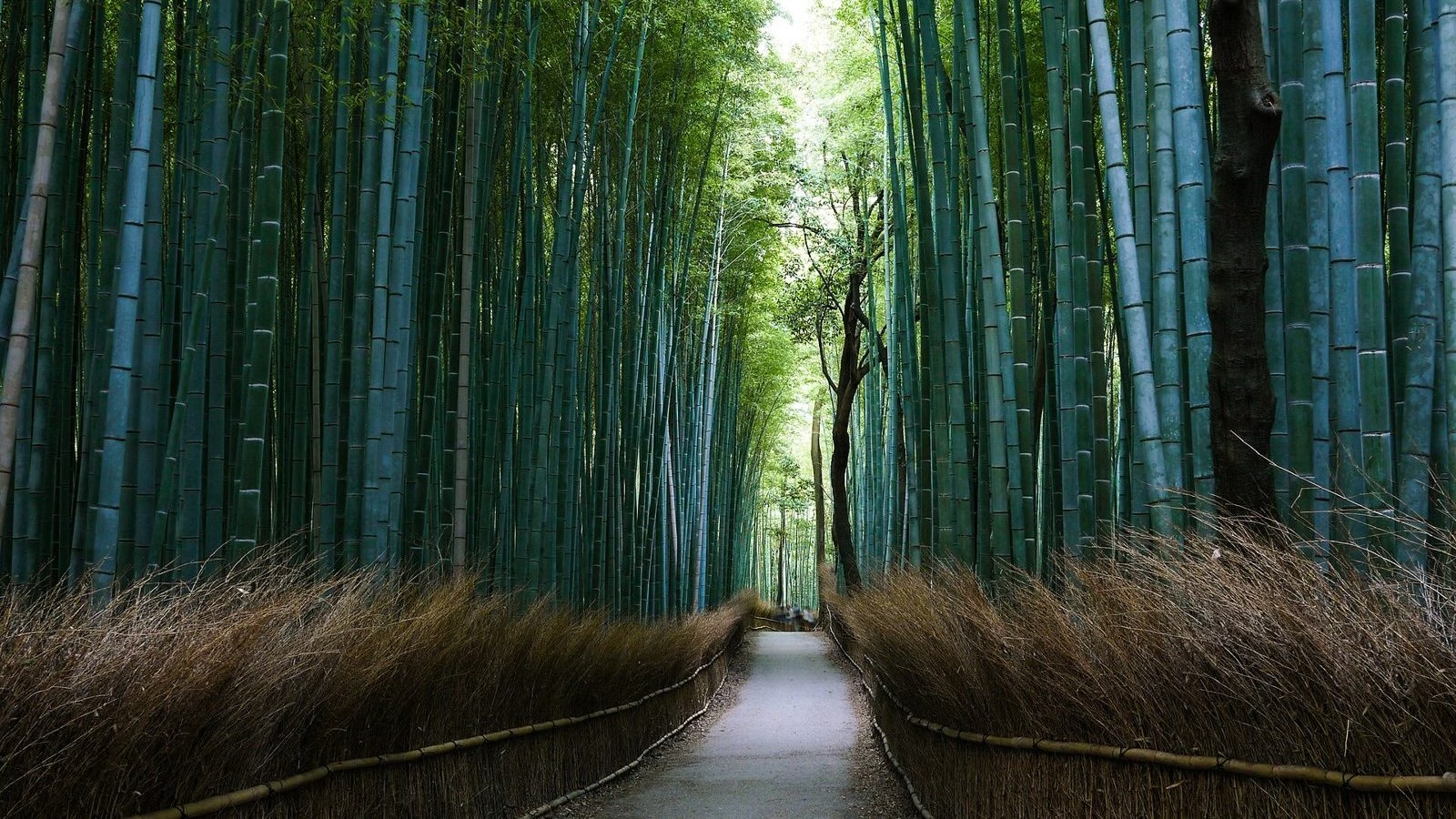
The first thing you notice in the Arashiyama Bamboo Grove is not the bamboo. It is the sound. A soft creaking, like an old wooden ship, and then a hiss as the wind moves through thousands of tall green stalks above your head. I stopped in the middle of the path, looked up, and for a few seconds the city and the crowd just disappeared. Just green light and that sound.
Arashiyama was the No. 2 spot in my top 10 places to visit in Japan, and it is part of my 10-day Japan luxury rail and ryokan itinerary. But this post is only about the place itself: why a bridge here is named after the moon, how an emperor’s villa became one of Kyoto’s greatest Zen temples, what makes the bamboo grove famous, and the monkeys, gardens and river that most people miss. So here is everything you need to know about Arashiyama.
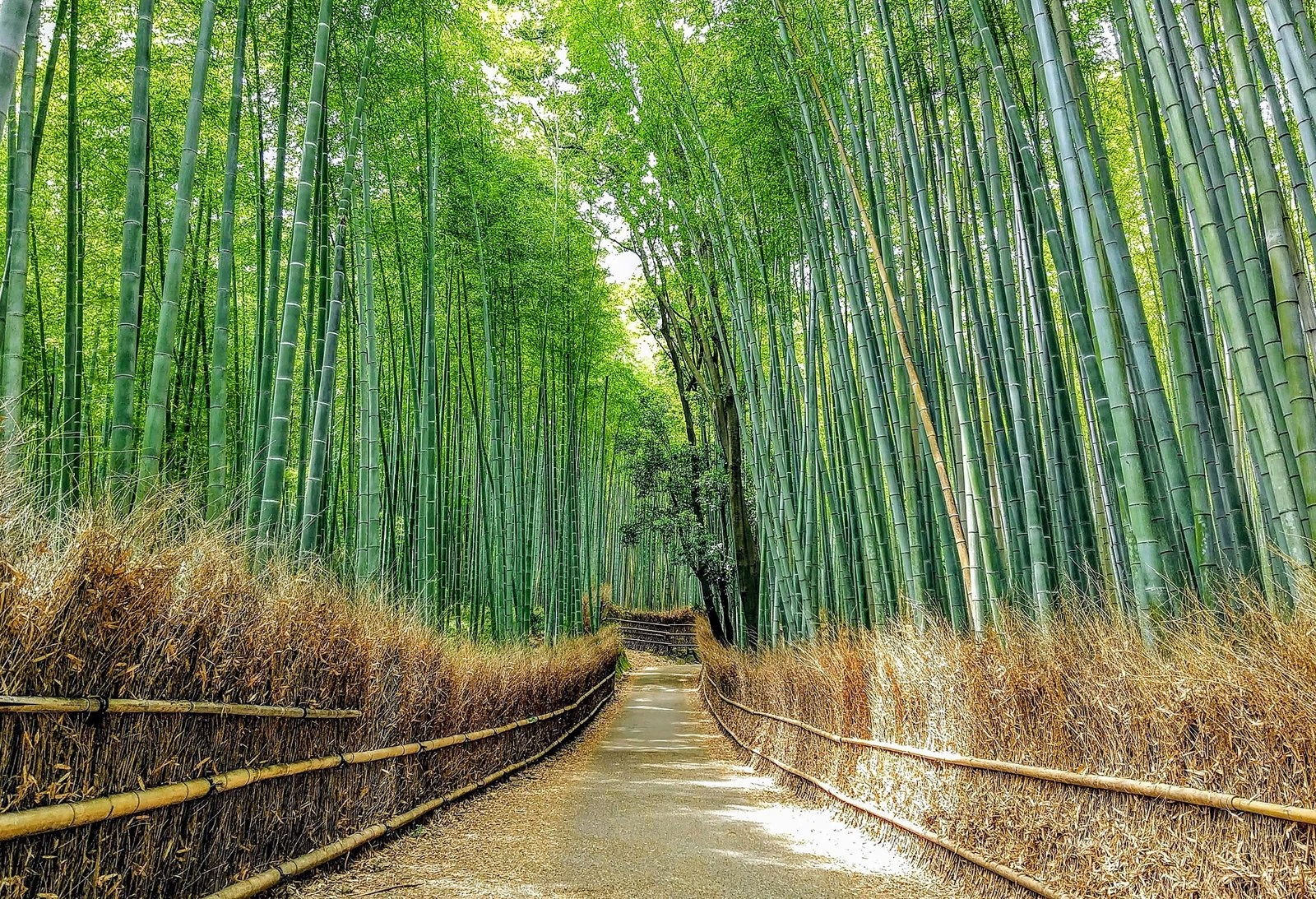
Photo: Naokijp, Wikimedia Commons, CC BY-SA 4.0. Original composition; resized for web.
Arashiyama: what it actually is
Arashiyama is a district on the western edge of Kyoto, and it is also the name of the mountain that rises across the river from it. The name means Storm Mountain. For more than a thousand years, emperors and nobles came here to escape the city, float on the river, write poems about the cherry blossoms and the autumn leaves, and build villas in the hills. The whole area is a nationally designated historic site and place of scenic beauty in Japan.
What surprised me is how much is packed into one small, walkable corner. On one side of the river you have a World Heritage Zen temple, a bamboo forest, a tiny shrine from The Tale of Genji and an old film star’s hillside garden. On the other side, wild monkeys sit on a hilltop looking down at the whole city. And the river in between has its own 400-year story. The area just to the north is often called Sagano, and you will see both names used for the same neighbourhood.
Togetsukyo: the bridge the moon crosses
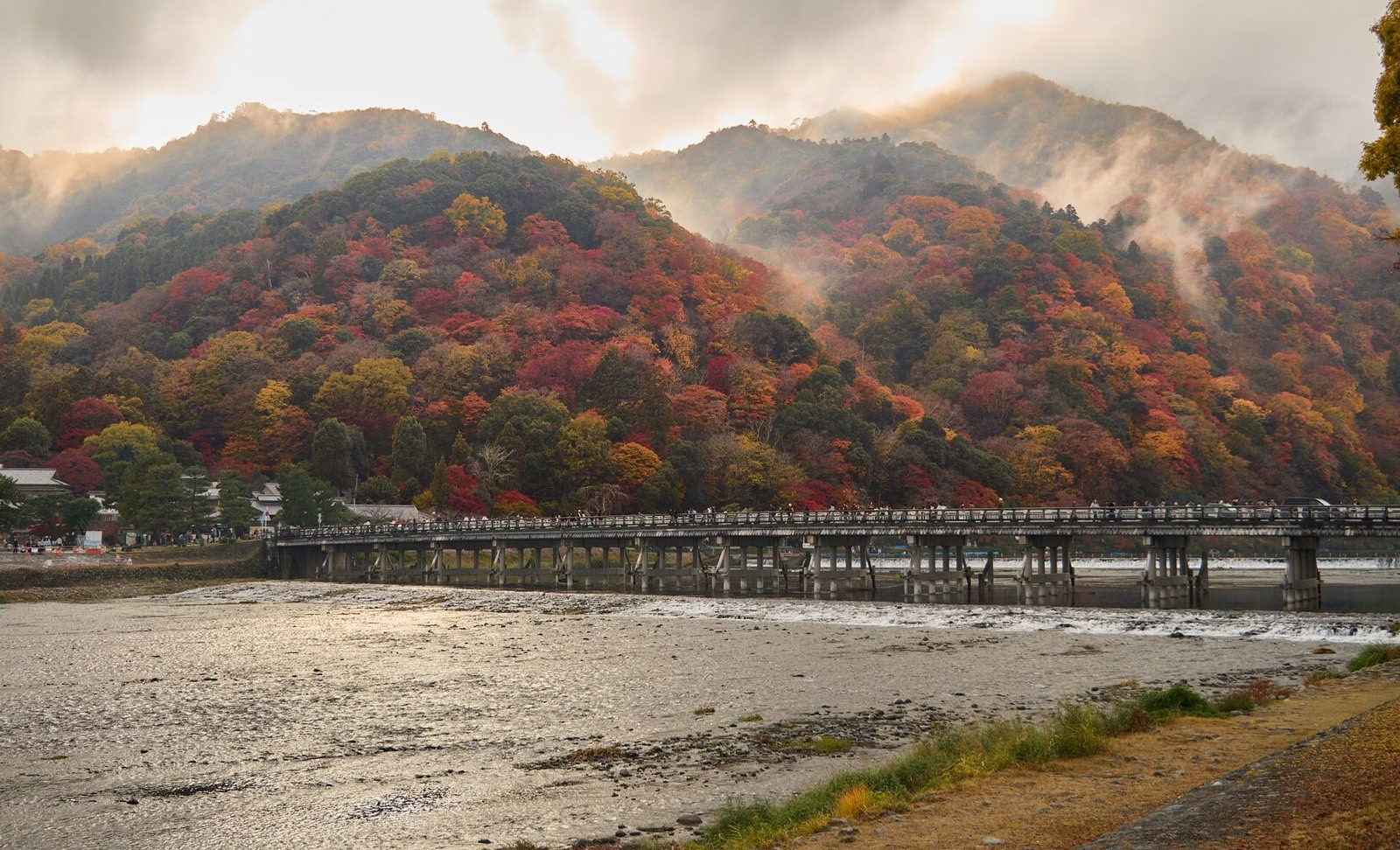
Photo: lumoplank, Wikimedia Commons, CC0. Original composition; resized for web.
Togetsukyo is the long, low bridge that you see in almost every photo of Arashiyama, with the mountain rising right behind it. It is about 155 metres long. A bridge is said to have first been built here in 836 by a monk named Dosho, and back then it was called Horinji Bridge, after Horin-ji, a temple across the river. The bridge you walk on today was finished in 1934. It looks like old wood, but the columns and beams are actually reinforced concrete, and only the railings are made of cypress, so that it still blends into the scenery.
The name is the best part. Togetsukyo means moon crossing bridge. The story goes that Emperor Kameyama, who lived here in the 13th century, was out on a boat on a clear full-moon night. Watching the moon move across the sky above the bridge, he said it looked like the moon was crossing it. The name stuck. Stand on the bridge at dusk, look at the mountain, and you will understand why an emperor got poetic here.
One more thing that confuses everyone: the river has three names. Upstream it is the Oi River, through the gorge it is the Hozu River, and below the bridge it becomes the Katsura River. Same water, three names, so do not worry if the signs and maps disagree.
Tenryu-ji: a temple born from an emperor and a dragon dream
Tenryu-ji is Arashiyama’s UNESCO World Heritage temple. It is the head temple of the Tenryu-ji branch of Rinzai Zen Buddhism, and it was ranked first among Kyoto’s Five Mountains, the top Zen temples of the city. In 1994 it was listed by UNESCO as part of the Historic Monuments of Ancient Kyoto. But the story of how it was born is pure drama.
This land was once the Kameyama Palace, the villa of the same Emperor Kameyama who named the bridge, and his grandson, Emperor Go-Daigo, grew up here. Go-Daigo later fought the shogun Ashikaga Takauji, a former ally who became his enemy, and lost. When Go-Daigo died in 1339, Ashikaga built a temple on this site in his memory, with the famous Zen master Muso Soseki as its first abbot. It was going to get a different name, until Ashikaga’s brother Tadayoshi dreamt of a golden dragon flying over the river. So it became Tenryu-ji, the temple of the heavenly dragon. To pay for it, trading ships known as Tenryu-ji ships were sent to China.
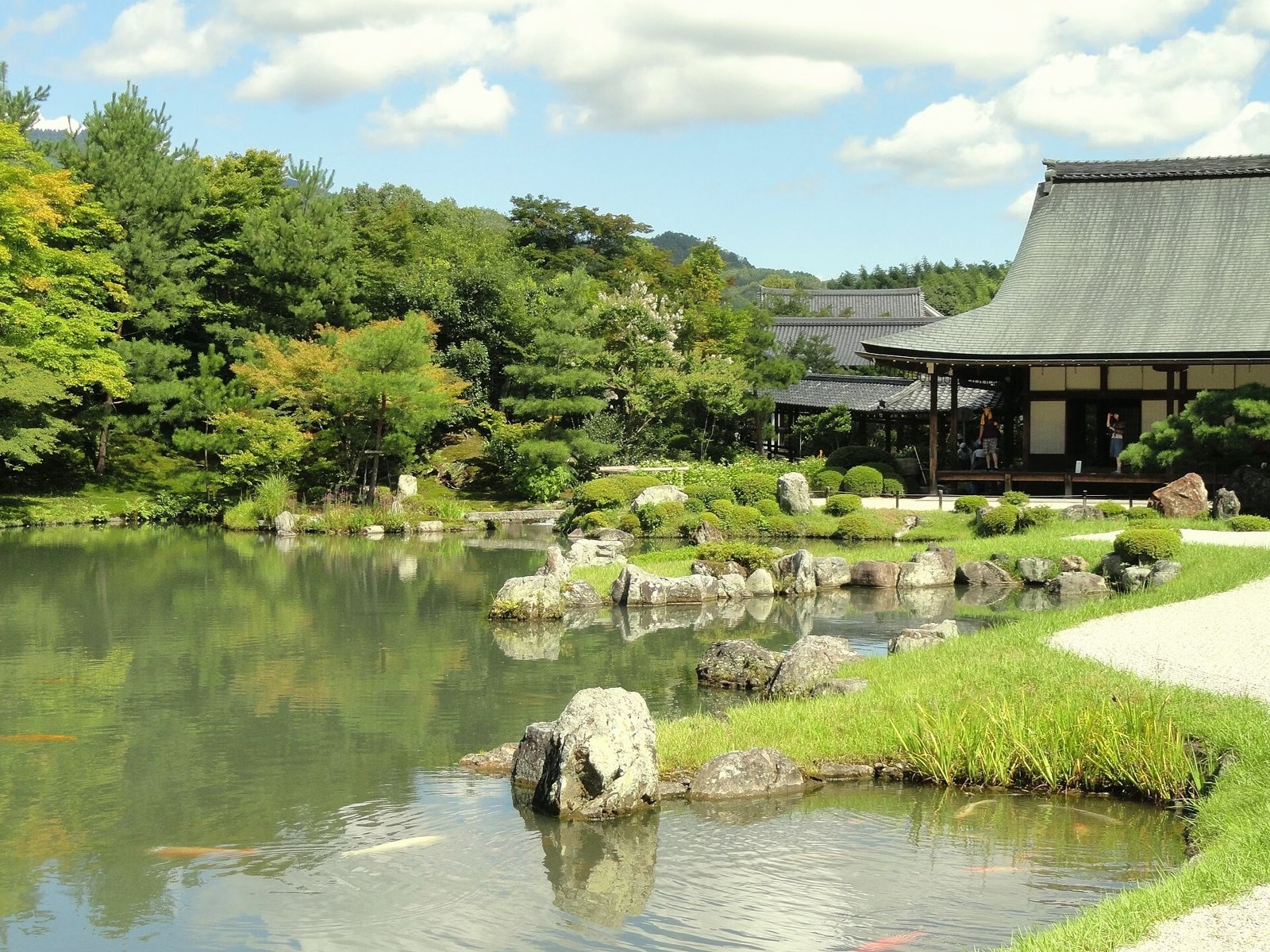
Photo: Daderot, Wikimedia Commons, CC0. Original composition; resized for web.
Here is the sad part: the temple burnt again and again. The temple counts eight major fires, and one of the worst came during the fighting of 1864, so most of the buildings you see now were rebuilt from the late 1800s. Only the old Buddha statue in the abbot’s hall, older than the temple itself, came through all eight fires undamaged. Look up when you enter the Hatto, the Dharma Hall: on its ceiling is a huge Cloud Dragon painted in 1997 by the artist Kayama Matazo. It is painted so the dragon seems to stare straight at you wherever you stand. The Hatto is opened on weekends, holidays and during special seasonal openings, so check the temple’s official website before you go if the dragon is a must for you.
If you want a quiet, very Zen lunch, the temple has its own vegetarian restaurant, Shigetsu, serving shojin ryori, the plant-based cooking of Buddhist monks. It sits on one of the ten scenic spots that Muso Soseki himself picked around the temple.
Sogenchi Garden: 700 years and still the same view
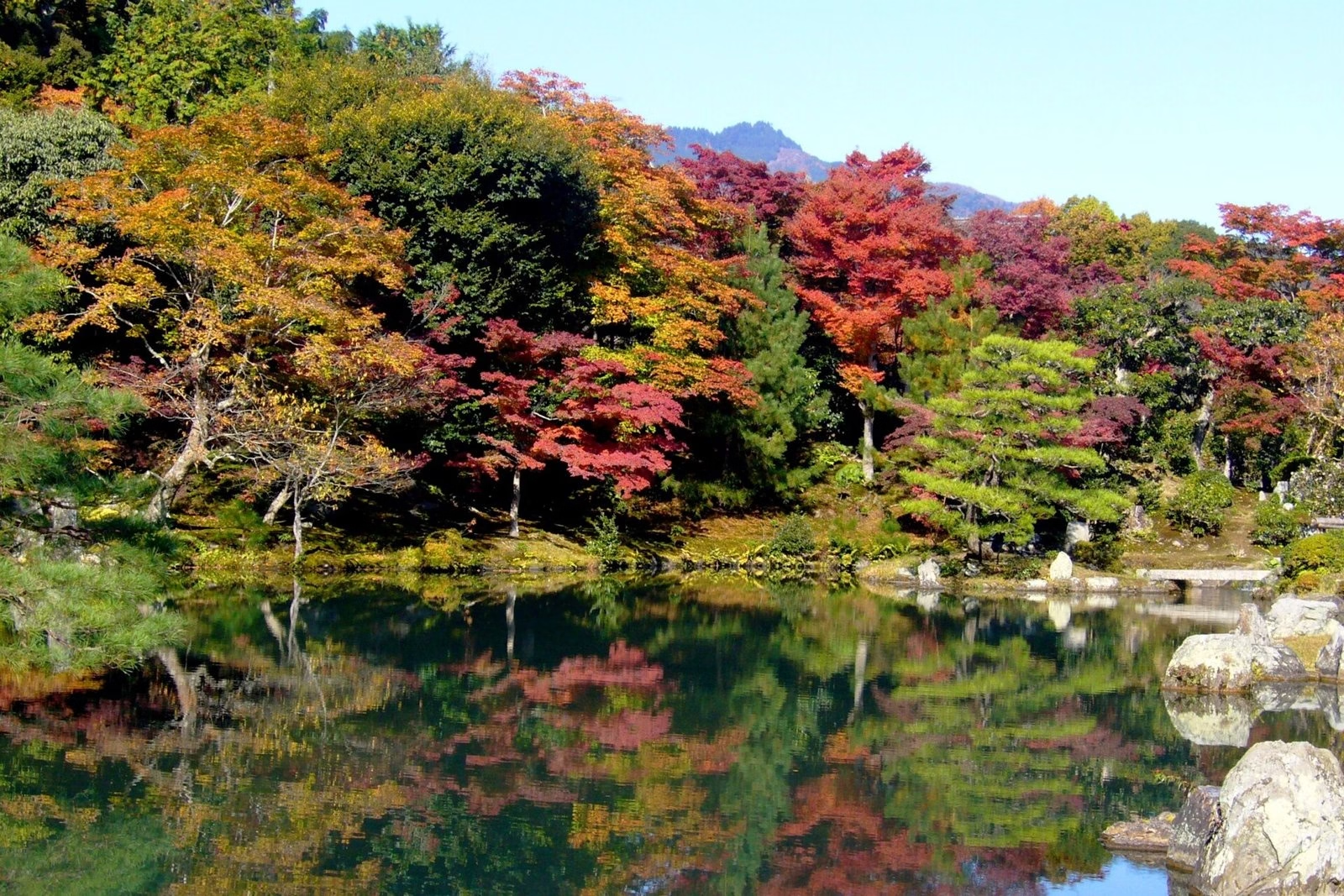
Photo: ttshr1970, Wikimedia Commons, CC BY 3.0. Original composition; resized for web.
Most of Tenryu-ji’s buildings are little more than a century old, but the garden behind them is not. The Sogenchi Garden was laid out by Muso Soseki nearly 700 years ago, and the temple says it still keeps its original look. An illustrated guide to Kyoto printed in 1799 shows it almost exactly as it is today. It was also the first place in Japan to be named a Special Historic Site and Place of Scenic Beauty by the government.
Sit on the veranda of the abbot’s hall and look straight across the pond. You will see a group of tall standing rocks on the far bank. They represent the Dragon Gate Falls of an old Chinese legend, where any carp that manages to swim up the waterfall turns into a dragon, a symbol of enlightenment in Zen. Here the carp stone sits to the side of the falls, showing a fish halfway through becoming a dragon. And behind it all, the hills of Arashiyama and Kameyama are used as part of the garden, a trick called borrowed scenery. Then get up and walk the path around the pond, because the picture changes at every turn.
The name Sogenchi itself has a story. When Muso Soseki was clearing mud from the pond, he is said to have found an old stone inscribed with the words Sogen itteki, a Zen phrase about one drop of water from the source, the truth flowing on through the centuries. He named the pond after it.
The Arashiyama Bamboo Grove: the sound of a forest
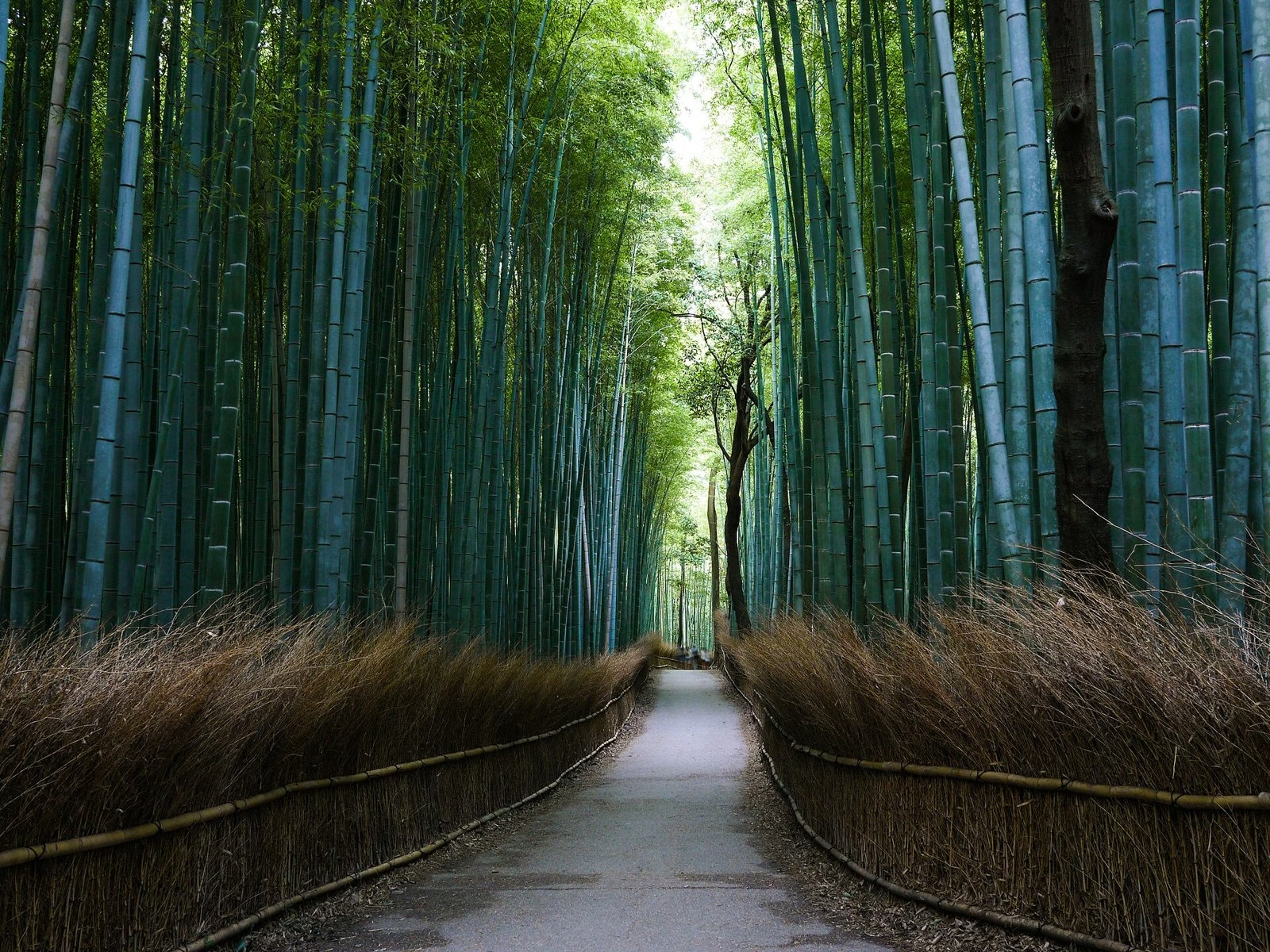
Photo: Ludovic Lubeigt, Wikimedia Commons, CC BY-SA 2.0. Original composition; resized for web.
Now for the place everyone comes for. The Arashiyama Bamboo Grove, also called the Sagano Bamboo Forest, is a forest of moso bamboo, the giant kind, with stalks shooting far above your head on both sides of a narrow path. Low brushwood fences line the way, and the light that comes through turns everything soft green. It is free to walk through, and the main stretch is short enough to finish quickly if you do not stop. But you will stop.
Remember the sound I talked about at the start? It is officially special. In 1996, Japan’s Ministry of the Environment picked the sound of the wind in this bamboo as one of the 100 Soundscapes of Japan, a list made to protect sounds that matter to people. Very few places get famous for how they sound. So when you come, stand still for a minute, put the phone down and just listen.
Honest truth: the grove can be packed shoulder to shoulder in the middle of the day, and then you hear only selfie chatter. The magic is early in the morning, before the tour groups arrive, when it is quiet enough to hear the bamboo creak. Do not expect a jungle trek either. It is a path through a forest, and the beauty is in walking slowly, looking up and noticing how the light changes.
Nonomiya Shrine: the black torii and the princesses of Ise
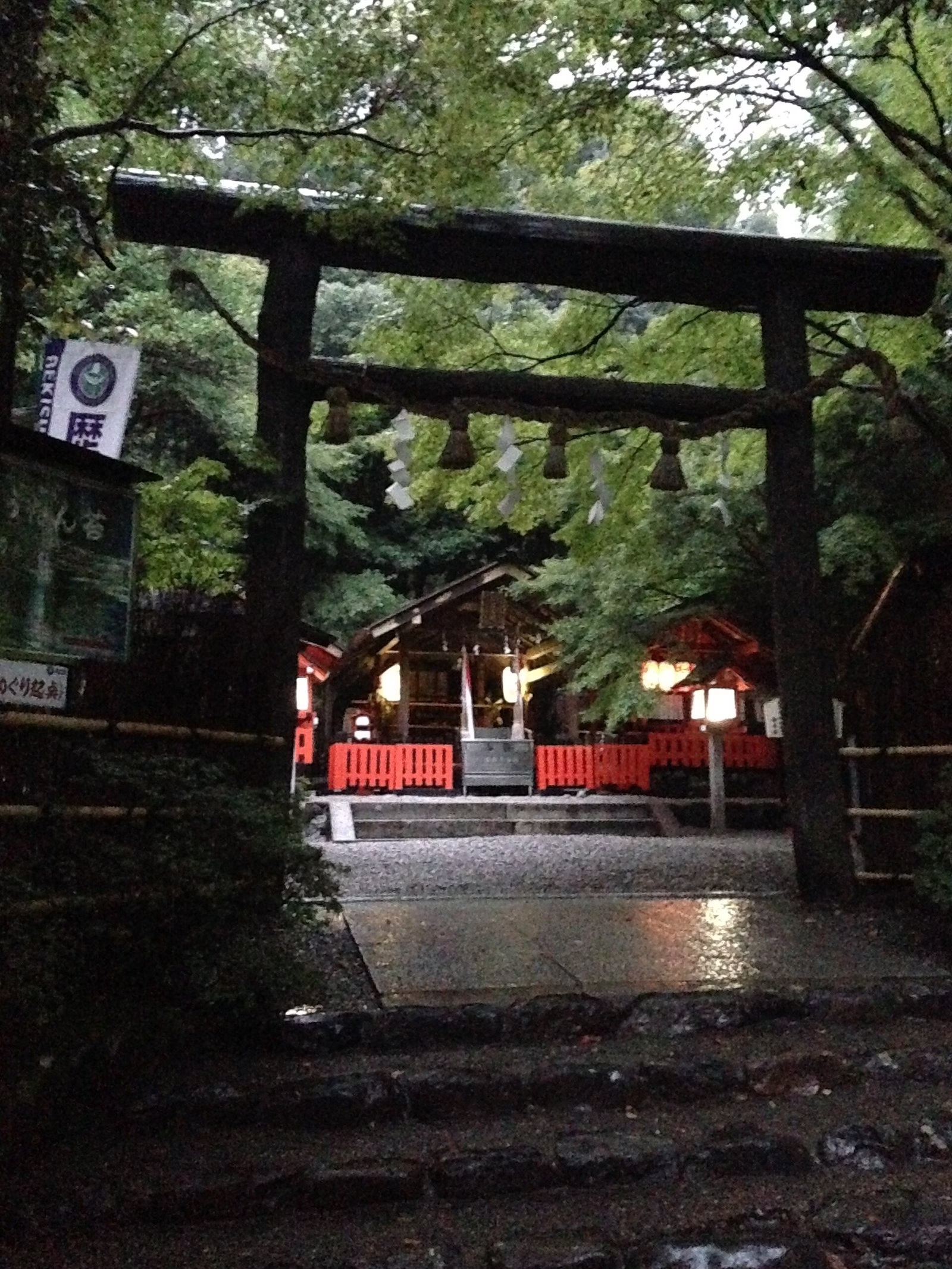
Photo: Soramimi, Wikimedia Commons, CC BY-SA 4.0. Original composition; resized for web.
Right on the edge of the bamboo forest is a tiny shrine that is easy to walk past, and you should not. Nonomiya Shrine has a very unusual gate: a kuroki torii, a black torii in the oldest style, made to look like logs with the bark still on, instead of the bright orange you saw at Fushimi Inari Taisha. Around it is a low fence of brushwood.
The story goes back to the Heian period, over a thousand years ago. Before an imperial princess could serve as the high priestess of the great Ise Shrine, she had to stay here for a year or more to purify herself. Nonomiya even appears in the tenth chapter of The Tale of Genji, often called the world’s first novel, where Prince Genji comes to visit Lady Rokujo while she stays here with her daughter, the chosen priestess. Today the shrine is popular with people praying for a good match and for safe childbirth, so you will see lots of young couples here.
Okochi Sanso: a film star’s 30-year garden
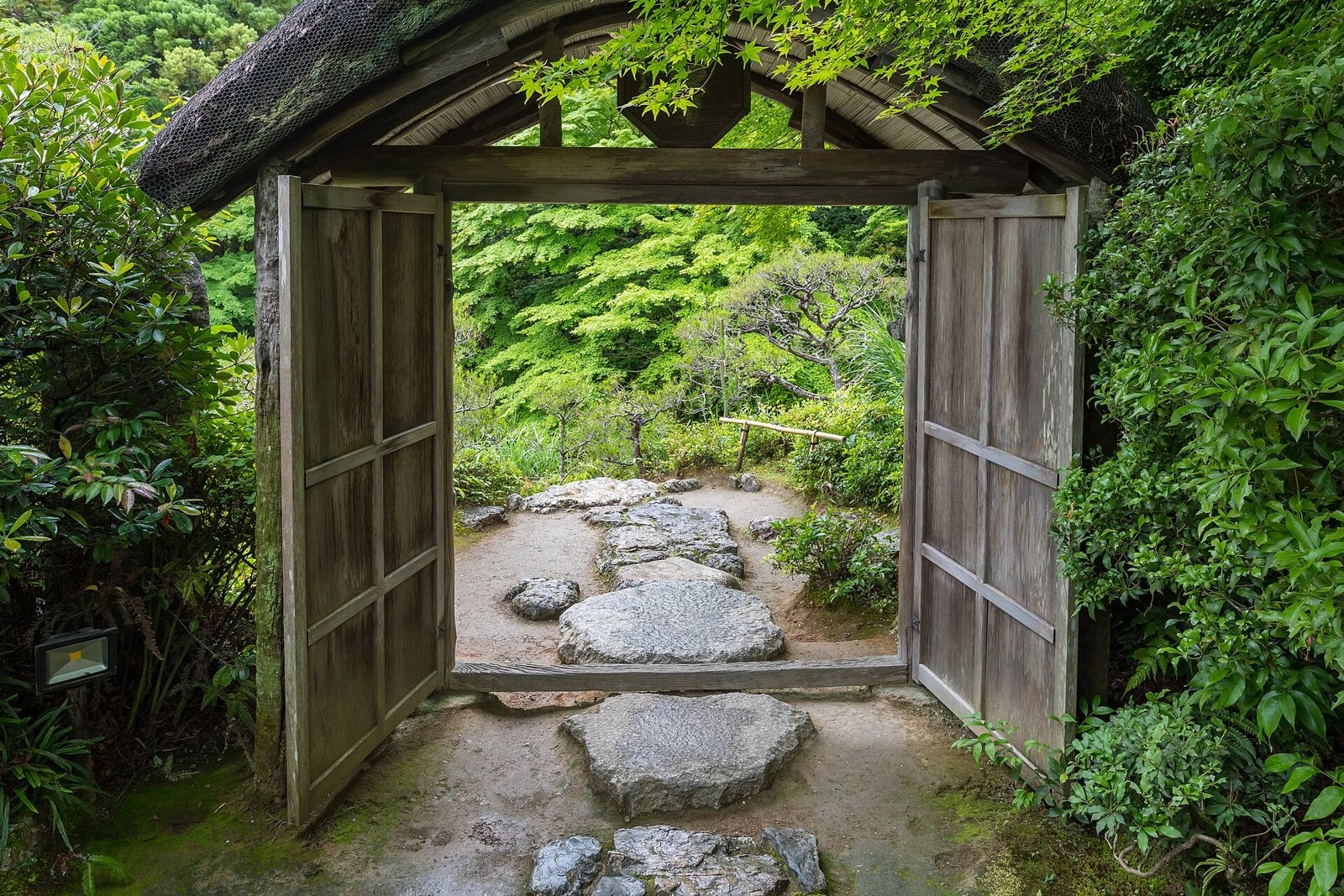
Photo: Basile Morin, Wikimedia Commons, CC BY-SA 4.0. Original composition; resized for web.
At the top end of the bamboo path, on the slopes of Mount Ogura, is my favourite surprise of Arashiyama. Okochi Sanso was the home and garden of Denjiro Okochi, a huge star of Japanese samurai period films in the 1920s to 1950s, who also acted for Akira Kurosawa. He spent about 30 years building this place, around 2 hectares of gardens, paths, tea houses and a Buddhist hall, and it opened to the public after his death in 1962. Several of its buildings are registered as cultural properties of Japan.
The gardens were designed to look good in all four seasons, and because the villa sits on a hill, the paths open up to views of Kyoto city, Mount Hiei and the Hozu River gorge. There is an entry fee, and that keeps it far calmer than the bamboo grove just below. After the crowd in the bamboo, walking these moss paths in near silence felt like someone had pressed mute on the world.
Iwatayama Monkey Park: wild macaques and the best view in town
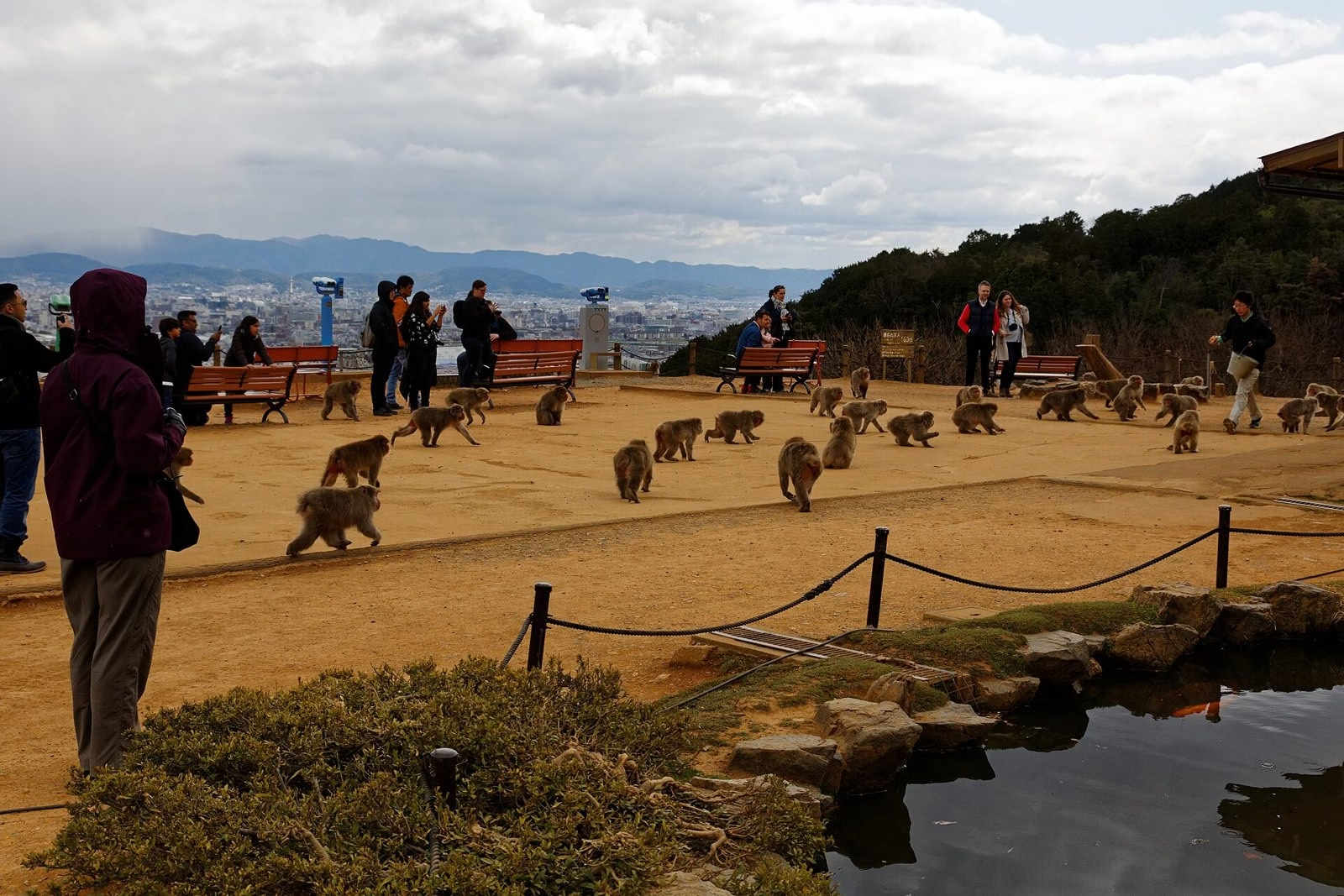
Photo: KimonBerlin, Wikimedia Commons, CC BY-SA 2.0. Original composition; resized for web.
Cross Togetsukyo to the other side of the river and you can climb to Iwatayama Monkey Park, home to a troop of about 120 wild Japanese macaques. They are not in cages. Researchers from Kyoto University began studying them in 1954, the park opened in 1957, and from that time the staff have given a name to every single monkey in the troop. Researchers still visit regularly to study them.
The walk up from the entrance takes about 20 minutes, with over 100 steps at the start and then a gentler slope through the forest. At the top, about 160 metres up, you reach an open clearing with monkeys lounging, grooming and chasing each other, and a view over almost the whole of Kyoto city. Try to spot Kyoto Tower. The funny twist is the feeding: you go inside a hut, buy a bag of food, and feed the monkeys through the wire mesh. The humans are in the cage, not the monkeys.
The park has a few rules, and they are for your own safety. Do not touch the monkeys, do not stare into their eyes, and keep about 2 metres away from them outside the hut. Feed them only inside the hut and only with food bought there, never your own snacks. Pets, drones and smoking are not allowed. Keep food out of sight on the way up.
The Hozu River: from timber rafts to royal boat rides
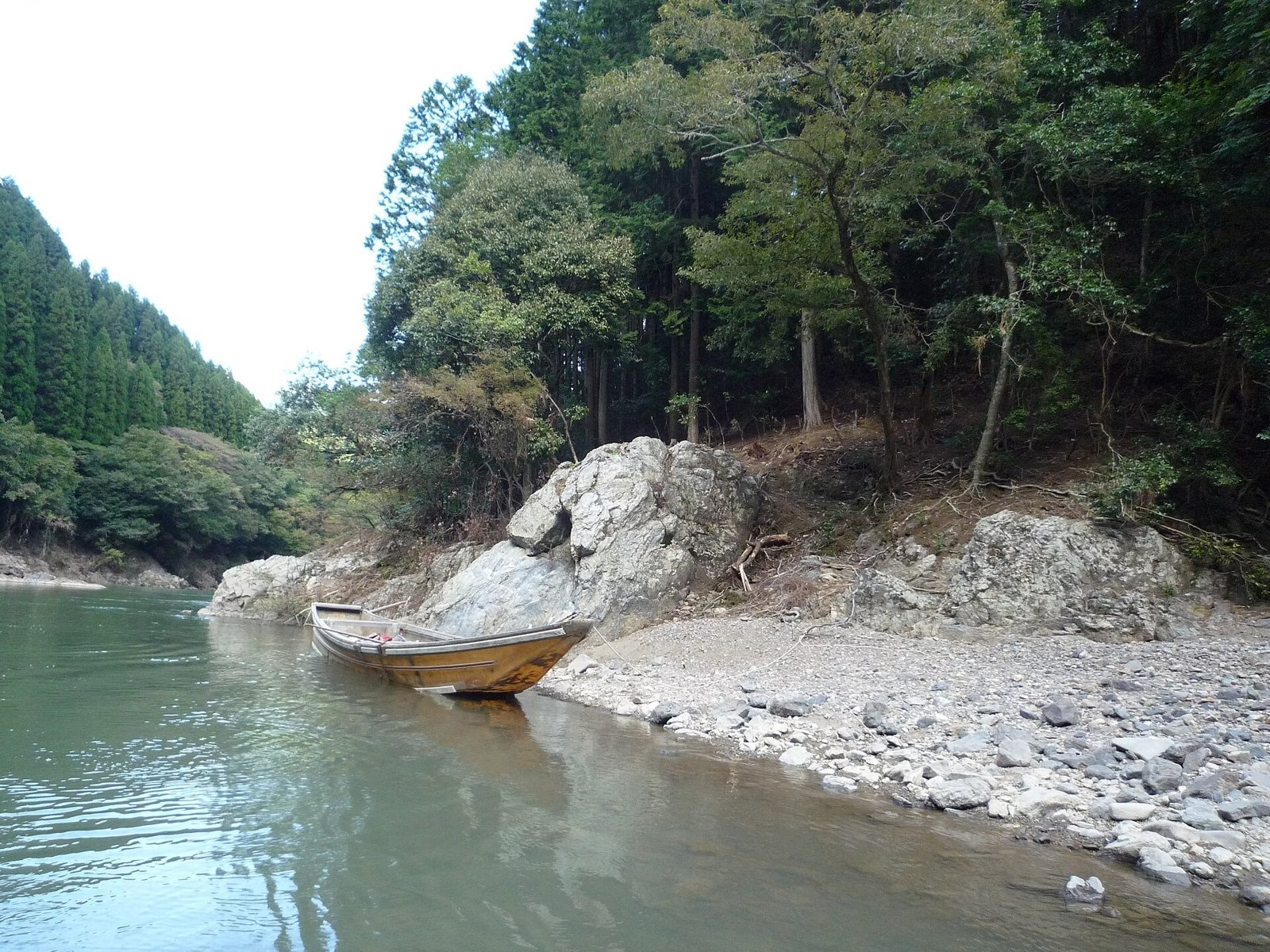
Photo: Sjaak Kempe, Wikimedia Commons, CC BY 2.0. Original composition; resized for web.
The river that flows under Togetsukyo has been working for Kyoto for more than 1,200 years. Long ago, raftsmen floated timber down it from the forests of Tanba to build the capital. Logs for temples and castles, including Tenryu-ji itself, came down this way. But the rocky gorge was too wild for boats until 1606, when a rich merchant named Suminokura Ryoi paid to break rocks, dig the riverbed and open it up. He brought boatmen and boatbuilders from elsewhere to teach the locals how to handle the rapids.
That river trade died out once trains and trucks arrived, but the boats found a new life carrying sightseers instead of rice and timber. In 1881, two grandsons of Queen Victoria, one of them the future King George V, rode down the river. Today the Hozugawa river boat ride runs about 16 km down the gorge from Kameoka to Arashiyama in about two hours, in flat-bottomed wooden boats steered by three boatmen with oars, a rudder and long bamboo poles, the same three-man method used for around 400 years. If you would rather see the gorge from above, the Sagano scenic train also runs along it. Even if you do neither, sit by the river near the bridge and watch the boats come in. It is a lovely way to end the day.
Manners and practical tips
- Entry to the bamboo grove is free. Tenryu-ji, Okochi Sanso and the monkey park charge separate entry fees, so carry some cash as well as a card.
- Wear comfortable walking shoes. Arashiyama is made for walking, and the monkey park climb and the Okochi Sanso paths have steps and slopes.
- In the bamboo grove, do not touch, carve or write on the bamboo, and do not step over the fences for photos.
- At Tenryu-ji, take off your shoes before going into the halls, and keep your voice low on the verandas where people sit and look at the garden.
- At Nonomiya Shrine, bow once before passing under the torii, and walk along the sides of the path, because the centre is believed to be the way of the god.
- Do not block the narrow paths or the bridge for long photo shoots. Step aside and let people pass.
- Some halls do not allow photography inside, so look for the signs.
Best time to visit Arashiyama
Arashiyama is beautiful in every season, but it is famous for two. In spring, cherry blossoms cover the slopes around the bridge, and in autumn the whole mountain turns red, orange and gold. Kyoto’s autumn colours are usually best from mid-November to early December, which is exactly when Arashiyama is at its prettiest, and also at its busiest. The rainy season usually runs through June and July, and summer is hot and humid. Winter is cold and much quieter.
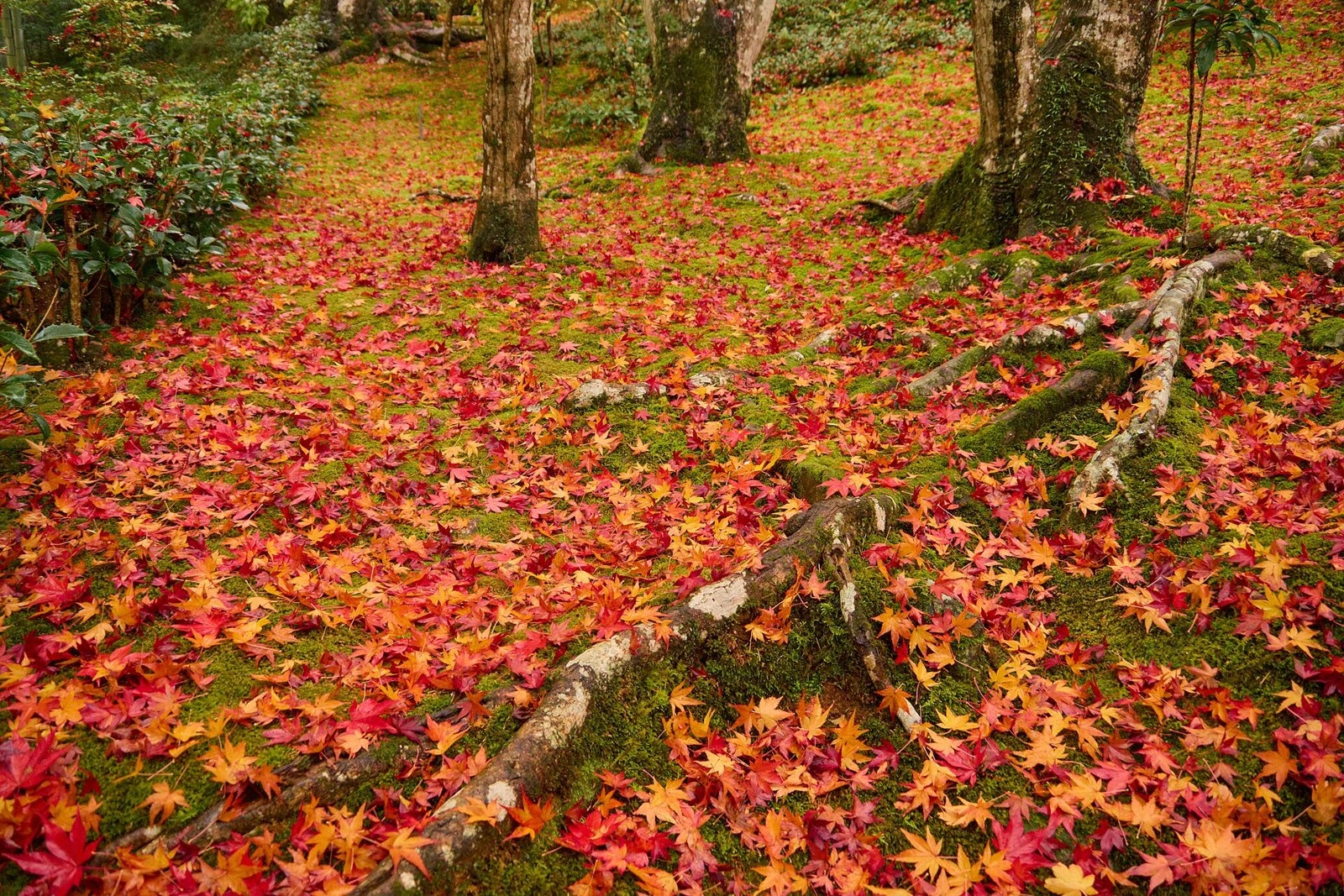
Photo: lumoplank, Wikimedia Commons, CC0. Original composition; resized for web.
Timing in the day matters even more than the season. Early morning is the best time for the bamboo grove, when it is quiet and the light is soft. Late afternoon and dusk are lovely by the river and on the bridge, when the day-trippers start heading home. To get the location of Arashiyama, click here.
FAQ
- Is the Arashiyama Bamboo Grove free?
Yes. Walking through the Arashiyama Bamboo Grove is free. Nearby places like Tenryu-ji, Okochi Sanso and the Iwatayama Monkey Park have their own entry fees.
- What is Arashiyama famous for?
Arashiyama is famous for its bamboo grove, the Togetsukyo Bridge, the World Heritage Zen temple Tenryu-ji and its Sogenchi Garden, the wild monkeys of Iwatayama and its autumn leaves and cherry blossoms.
- Why is Togetsukyo called the moon crossing bridge?
The story is that Emperor Kameyama, watching the full moon move across the sky above the bridge from a boat, said it looked like the moon was crossing it. Togetsukyo means moon crossing bridge.
- How long does it take to walk up to Iwatayama Monkey Park?
About 20 minutes from the entrance to the top, with over 100 steps at the start and a gentler slope after that.
- When is the best time to visit Arashiyama?
Early morning is best for the bamboo grove. For seasons, spring cherry blossoms and autumn leaves are the most beautiful, with Kyoto’s autumn colours usually best from mid-November to early December.
Final Thoughts
Arashiyama is the part of Kyoto that feels like a short story collection: a bridge named by an emperor, a temple named after a dream, a forest famous for its sound and a samurai film star’s secret garden. Go early, stop in the bamboo and listen, sit on the Tenryu-ji veranda for longer than you planned, and cross the river to say hello to the monkeys. Which one would you pick if you had time for only one? Tell me in the comments. For the rest of Japan, read my top 10 places to visit in Japan and my Fushimi Inari Taisha guide. And if old temples are your thing, see my Shore Temple Mahabalipuram guide, or for a very different kind of old-world street walk, my White Town Pondicherry guide.
Arashiyama is part of my 10-day Japan luxury rail and ryokan itinerary, which also covers Tokyo, Hakone, the rest of Kyoto and Okinawa. You can just use it for the number of days you have, book from its links and go, with no planning worries. If you want a custom version for your own dates, CLICK HERE to start on the trip form.
I plan the route. I don’t book the ferry, the stay, or the tickets. A custom plan is Rs. 200 per travel day. Fill the trip form, pay online, and I’ll send you the plan.