 By
The first time you see Theyyam, it does not feel like a performance you have bought a ticket for. It feels like you have walked into someone else’s prayer and been allowed to stay. A courtyard in Kannur or Kasaragod, lamps or a fire, drums that you feel in your chest, and then a figure in a towering red headdress whose face is no longer quite the face of the person who started painting it hours earlier. People do not clap. They stand, they bow, they wait to speak to the deity who has arrived.
Theyyam is the ritual I put at No. 1 in my top 10 places to visit in North Malabar, and it is one of the pillars of my 8-day North Malabar itinerary. A few lines in a list were never going to be enough for something this alive, so here is a fuller guide: what Theyyam actually is, when it happens, why Parassinikadavu is different, what you are looking at when the costume comes on, and how to watch it without turning a sacred night into a photoshoot.
What is Theyyam?
Theyyam is a ritual art of North Malabar, not a staged folk dance. Kerala Tourism places it mainly in Kannur and Kasaragod, with related forms in parts of Wayanad, northern Kozhikode and some areas of Karnataka. It is performed at family shrines, village kavus and temples, as an annual festival or as a special offering, and it honours a wide range of deities and figures: major goddesses, warrior heroes, forest and hunting gods, and even a few Muslim characters, which tells you something about how this tradition has lived among different communities on the same coast.
Kerala Tourism says there are nearly 400 different Theyyams, some major, some smaller. Names you will hear if you spend any time here include Muchilottu Bhagavathy, Kathivanur Veeran, Pottan and Muthappan, but the list is long and each shrine has its own calendar and its own favourite deities. The performers have traditionally come in large part from the Malayan and Vannan communities, and they prepare with a period of discipline called vrutham, with fasting, prayer and a carefully held way of life before the night of the ritual. When the Theyyam begins, the performer is not understood as an actor playing a god. For the village, the deity is present.
This is worship, not a show
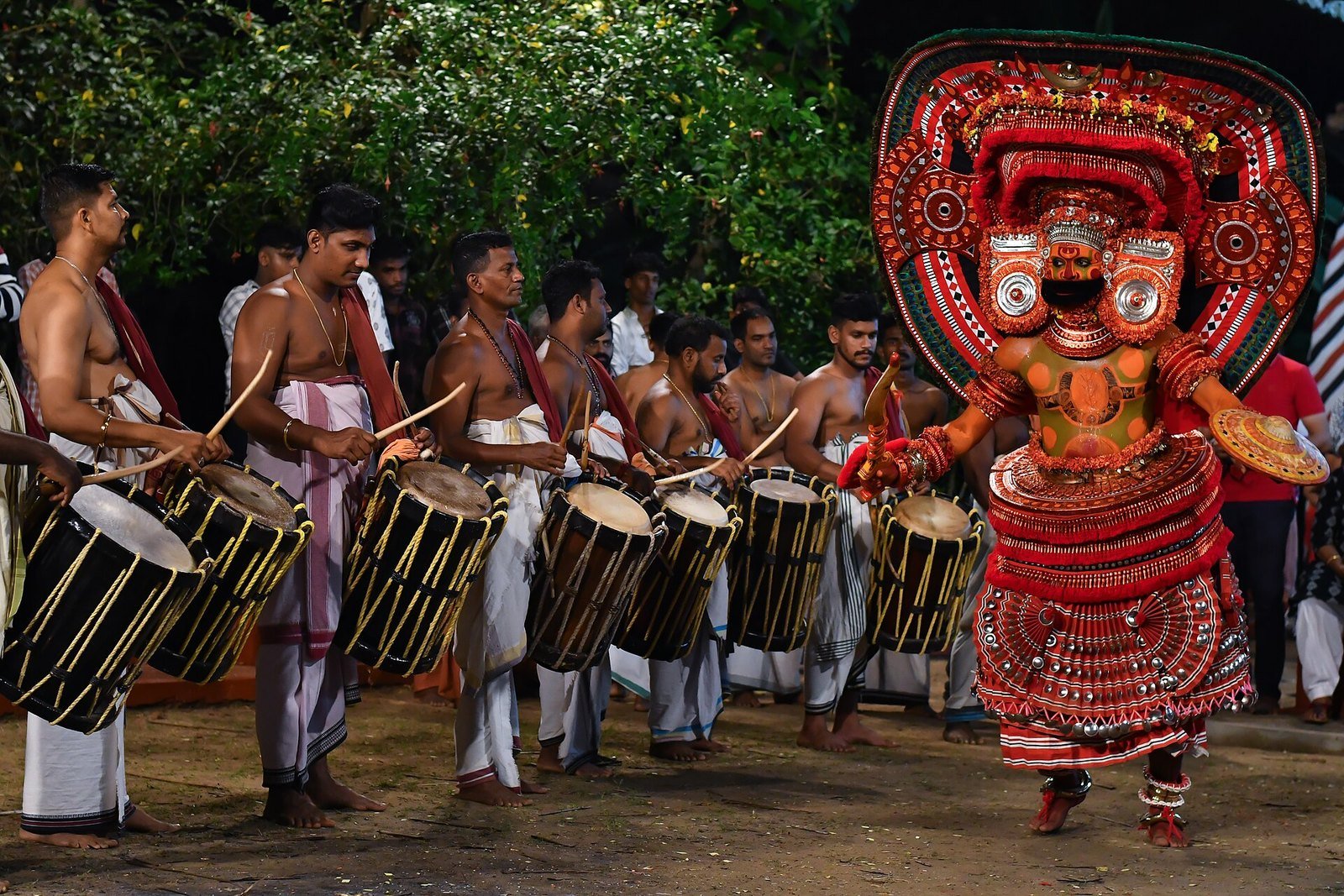
I want to be plain about this, because travel videos have made Theyyam look like a carnival. The drums, the fire, the costume and the night air are dramatic, and they photograph beautifully, but the people around you have come to ask for blessing, to offer thanks, or simply to stand in front of a deity their family has honoured for generations. If you keep that in your head, the rest of your behaviour follows quite naturally. You dress modestly, you take your shoes off where others do, you do not push to the front, and you do not talk over the ritual as if you were at a concert.
There is often a long wait. Makeup and the tying of the costume can take hours. The ritual may start later than a printed note suggested, or go on longer than you planned. That is not poor management. That is the nature of a living rite. If you only have a tight window and you are hoping for a guaranteed spectacle at a fixed minute, you will be frustrated, and you will also be in the wrong frame of mind. Go with time in your pocket, and let the night take the time it needs.
The season, and why winter is so special
The main Theyyam season, as Kerala Tourism sets it out, starts on the tenth day of the Malayalam month of Thulam, which usually falls in mid-October, and lasts until the middle of Edavam, typically late May. In those months, shrines across Kannur and Kasaragod hold their kaliyattam, and a traveller who asks around, or checks a current Theyyam calendar and then confirms with the local shrine, can see different deities on different nights. December to February is the most comfortable stretch if you are also going to the beaches and forts, because the weather is drier and the ritual calendar is full.
Outside that season, most village shrines go quiet. That is why so many people visit in winter, and why you should not assume you will find a Theyyam in every village in July. The important exception is Parassinikadavu, which I will come to in a moment. Festival dates move with the Malayalam calendar, so a date that was right last year may not be right this year. Confirm closer to the day, and treat any list you find online as a clue, not a ticket.
What you are looking at: paint, costume and drums
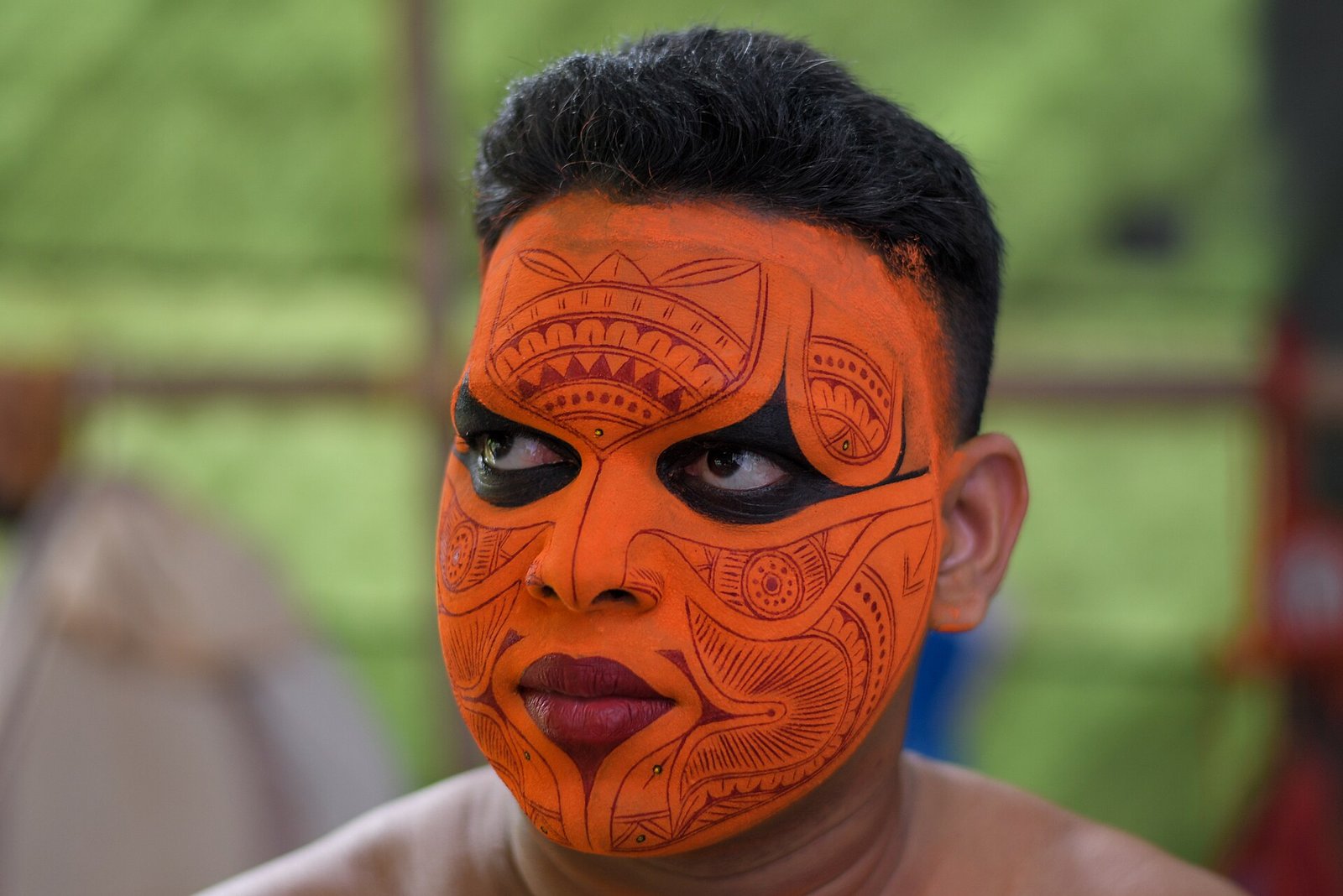
Even if you arrived only for the meaning, you will not forget what Theyyam looks like. The face is often a complete painted mask: flat colour, sharp black lines, patterns that belong to that particular deity. The eyes are made to look larger. The lips are formal. Once the paint is on, the performer’s everyday face recedes, and that is part of the transformation, not just decoration. It is slow work, done with care, and it is one reason the hours before a Theyyam matter as much as the moment in the courtyard.
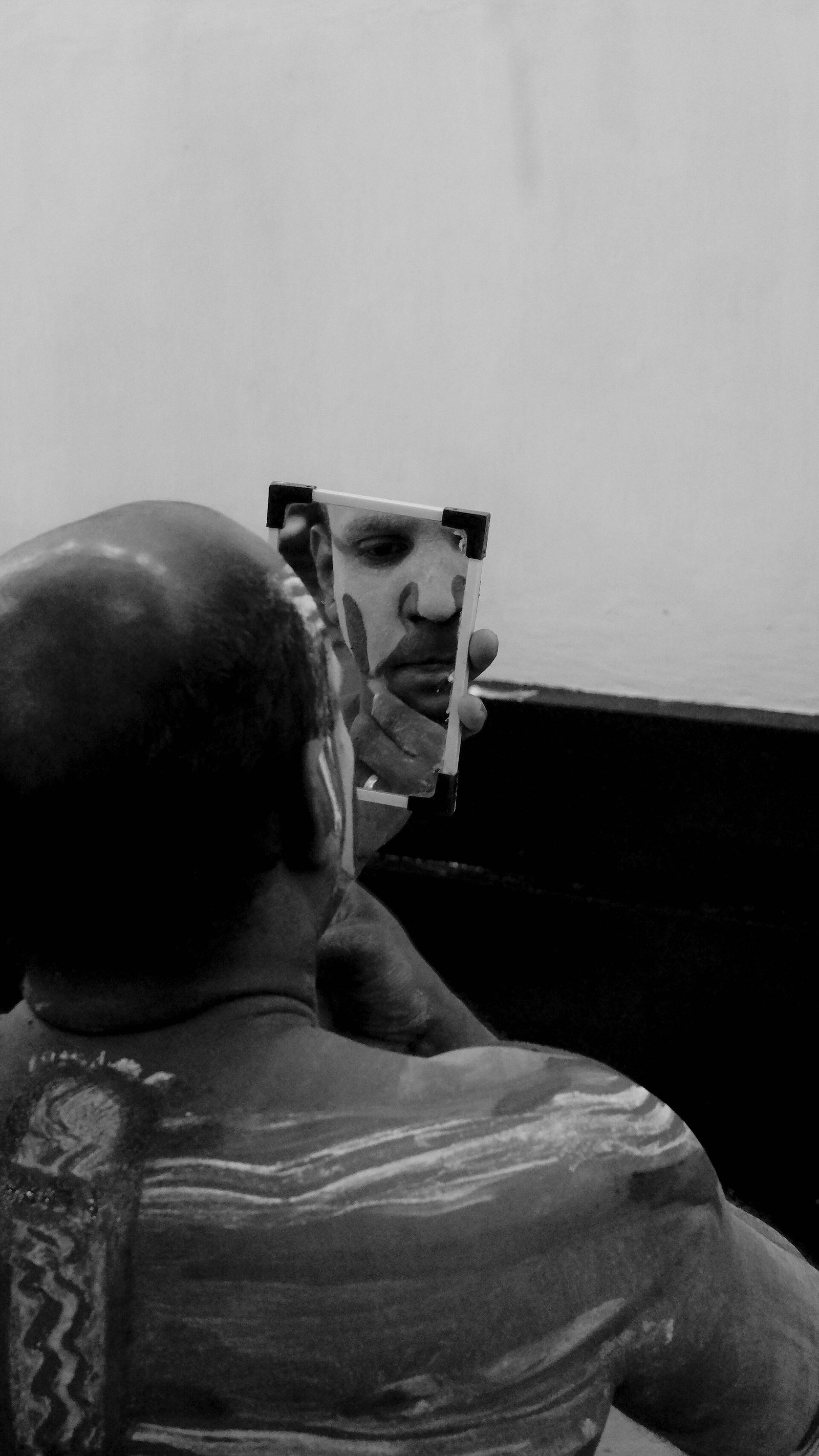
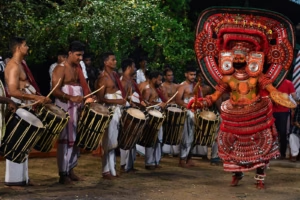
The body is painted too, and the costume is built in layers: red cloth, ornaments, a breastplate of shining pieces, sometimes a wide skirt-like lower structure, and then the mudi, the headdress, which can rise so high that the figure seems taller than the shrine itself. Some headdresses open like a fan or a halo of painted discs. Some Theyyams carry a small shield and a weapon. Some rituals involve fire, and you will see sparks lift off a pile of burning leaves or coconut fronds while the Theyyam moves around the flame. The sound is the chenda and related drums, and once they start in earnest the courtyard has a pulse.
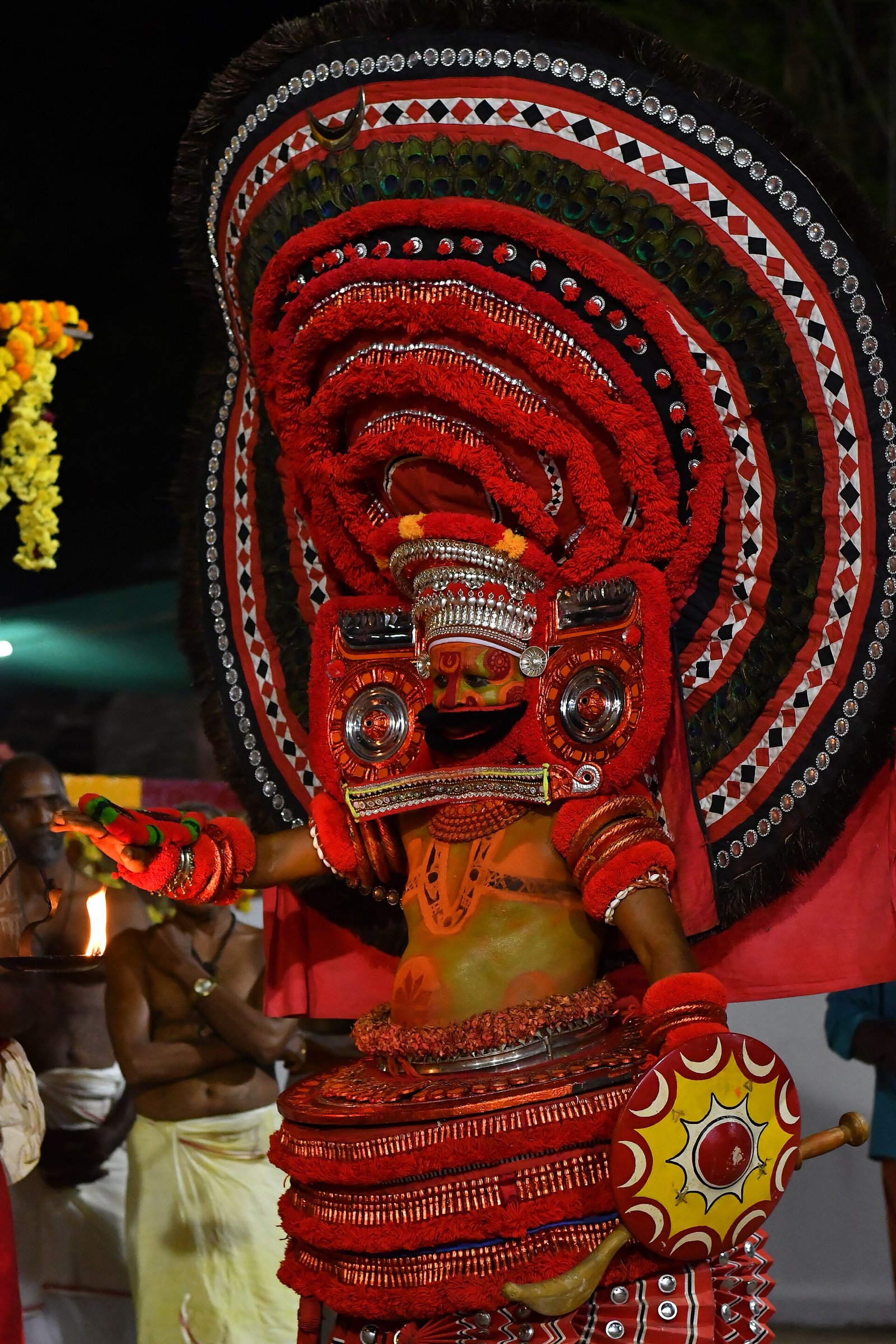
I would not get too busy trying to name every type from a single photograph unless someone at the shrine tells you. The safer, better thing is to watch one ritual properly. Notice how the walk changes, how the Theyyam addresses people, how the crowd knows when to move back and when to come forward. If you are lucky, you will see the Theyyam speak to devotees, sometimes sharply, sometimes with humour, in the way of a god who knows the family standing in front of him. That conversation is not a show for you. Give it space.
Village Theyyam: the night at the kavu
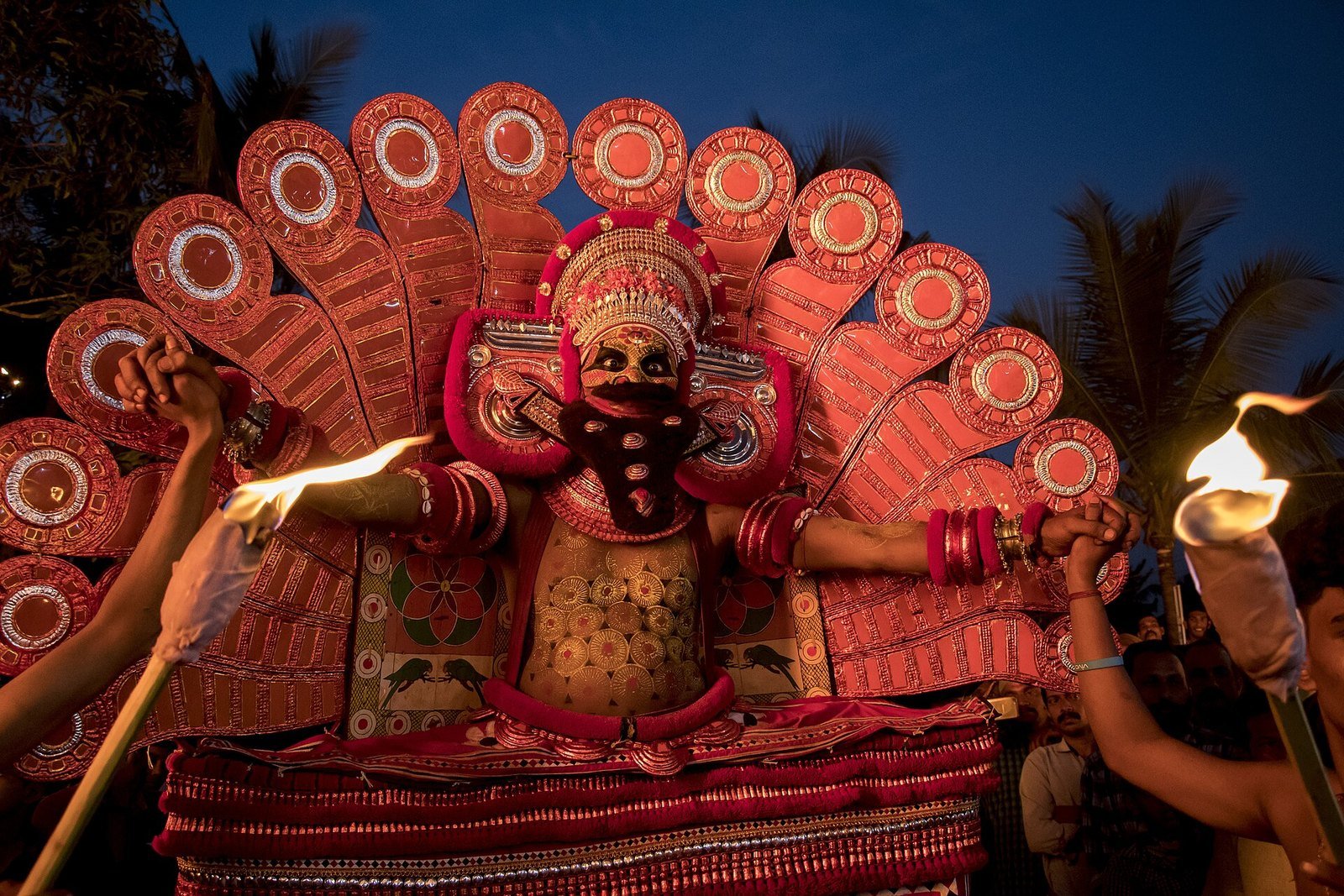
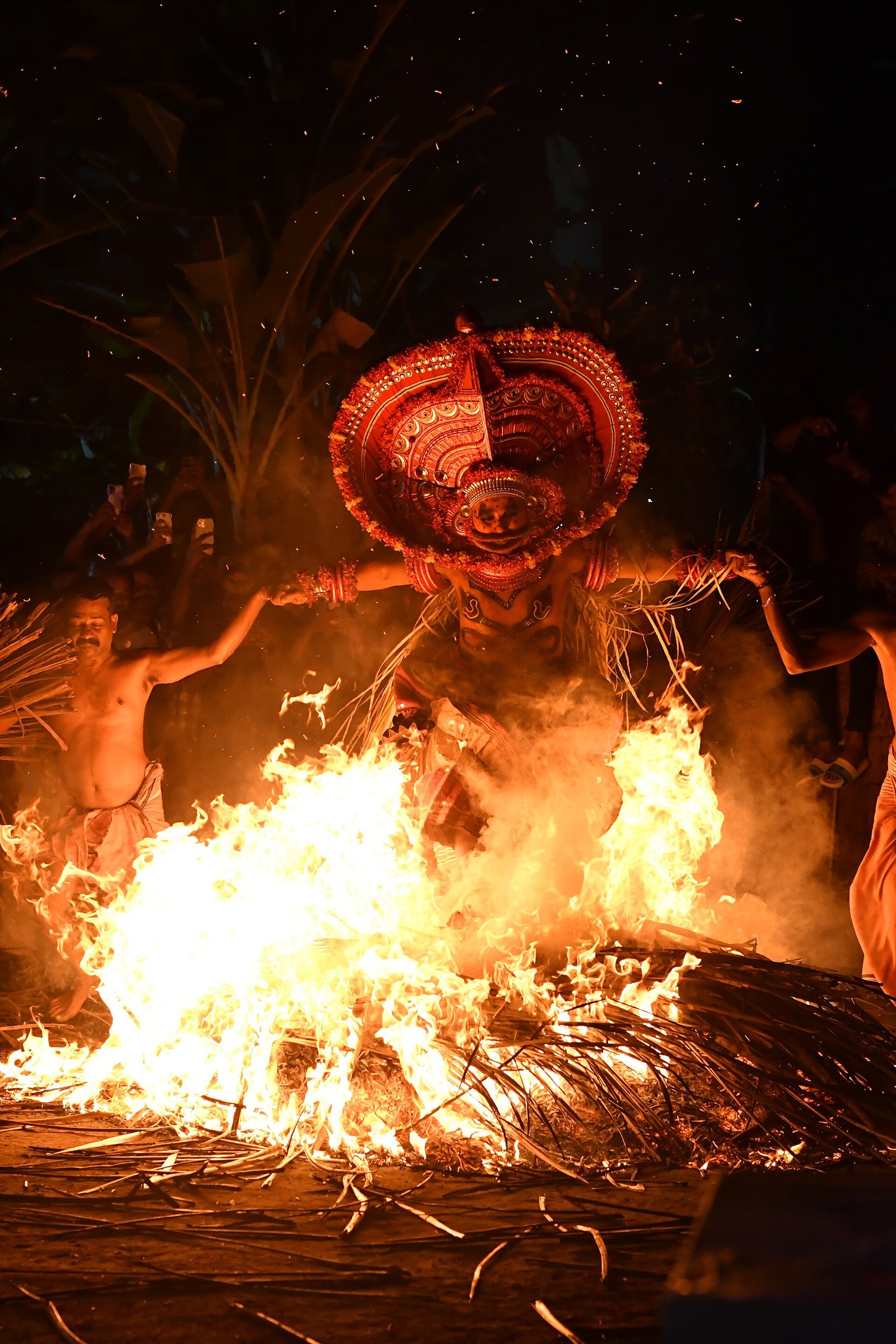
If you can see only one kind of Theyyam, try to see a village kaliyattam at a kavu, the local shrine. These are the nights when the whole setting does the work: a small shrine, trees at the edge of the courtyard, torches, families who have come from nearby houses, and a Theyyam whose headdress seems to fill the night. The photograph here is from a Theyyam at Kadachira in Kannur, and even in a still frame you can feel how close the crowd stands, and how the firelight sits on the costume. This is the North Malabar that does not exist for the camera. It exists because the village still needs it.
Finding a village Theyyam takes a little asking. Dates are local. Some nights are more important than others. A driver, a homestay host or someone at a nearby temple will often know what is happening that week, and a polite question goes further than a plan copied from a stranger’s blog. Go early enough to stand quietly, not at the last minute with a camera already raised. If you are travelling with children, they can come, but keep them close and keep them from wandering into the ritual space.
Parassinikadavu: the Theyyam you can see every day
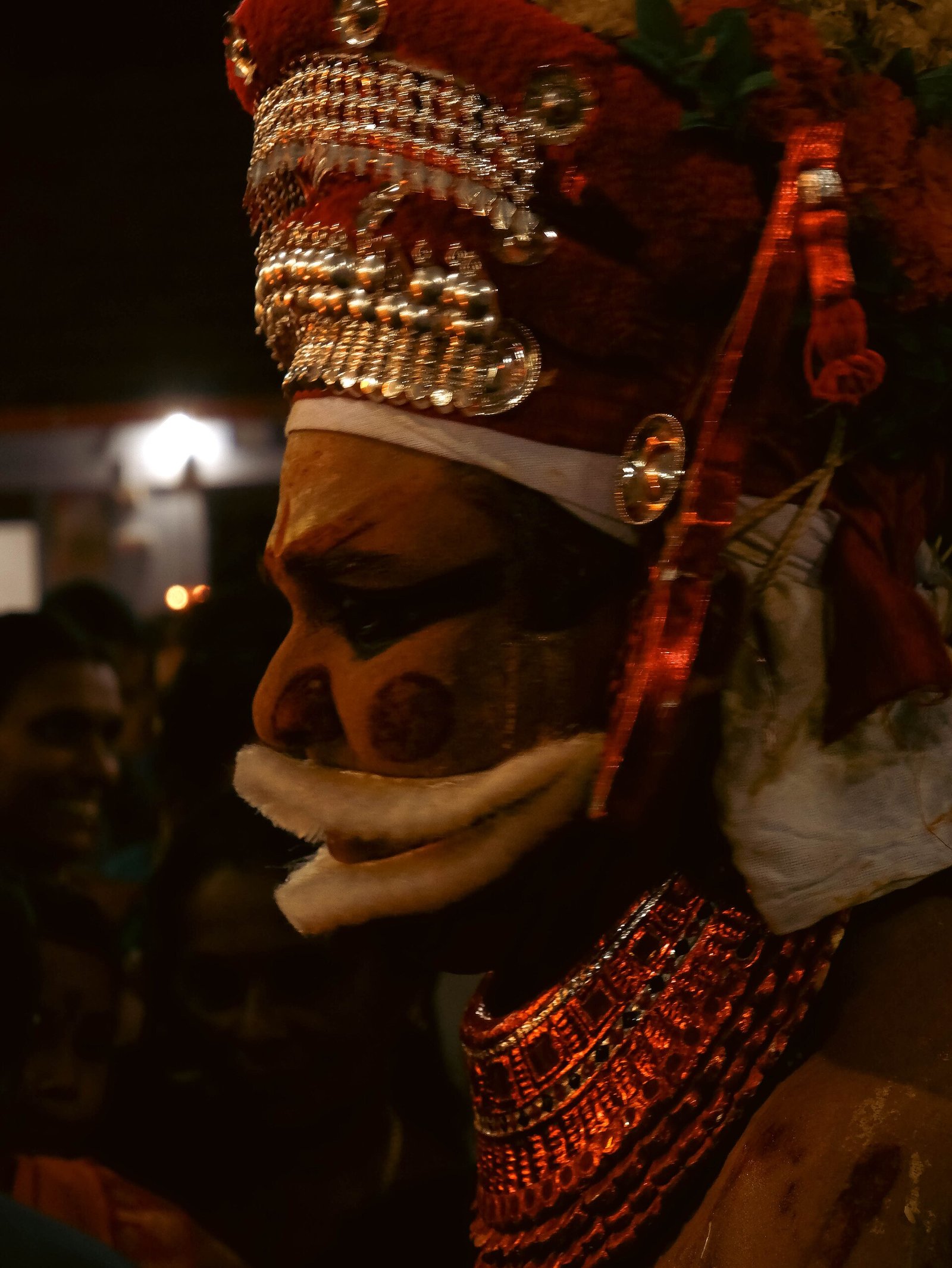
Parassinikadavu Sree Muthappan Madappura, on the bank of the Valapattanam river north of Kannur town, is the shrine most visitors hear about first, and for a good reason. Muthappan Theyyam is performed here every day of the year, which is rare. Elsewhere you wait for the season and for a particular shrine’s date. Here, the daily ritual is part of the life of the madappura. Muthappan is a much loved folk deity of this region, and the ritual form is often spoken of in two aspects: Vellattam and Thiruvappana, associated with Shiva and Vishnu. You will recognise Muthappan by the face as much as by the name, a painted face with a distinctive white beard and a red headdress, closer to a hunter god than to the taller, circular headdresses of some other Theyyams.
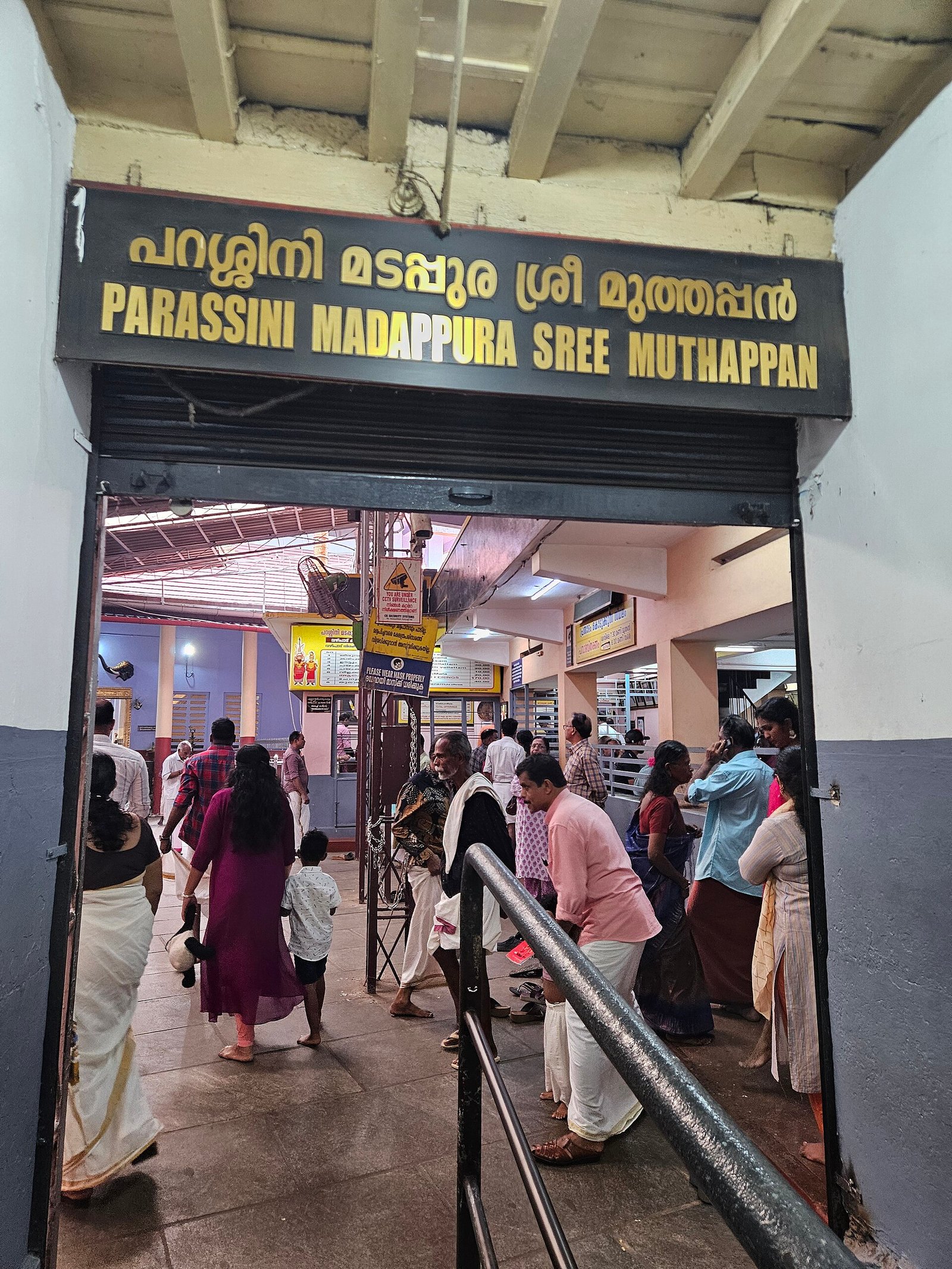
The shrine is known as a place where people of all faiths come, and that openness is part of Muthappan’s character. Traditional offerings here include toddy and dried fish, which surprises visitors who expect every Kerala temple to follow the same rules, and the madappura is also known for serving prasadam to those who come, a simple vegetarian meal and the usual temple hospitality of tea and a small bite. Confirm the day’s dawn and evening ritual times with the temple, because living shrines do not run like railway timetables, and arrive with enough margin that you are not rushing at the door. To see the shrine on the map, click here.
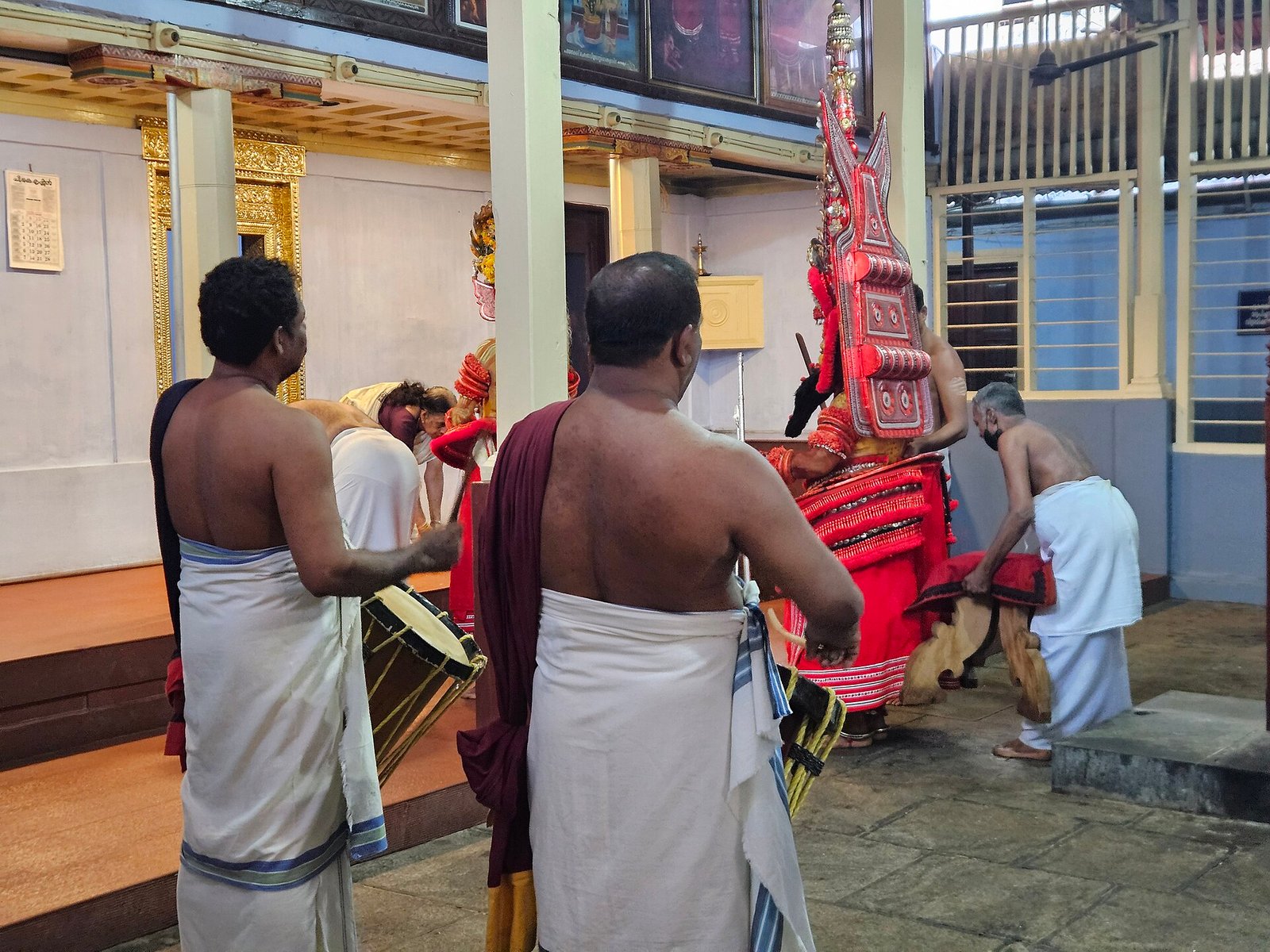
Inside, the daily Theyyam happens in the shrine itself, with drums, a close crowd and the red figure of Muthappan moving through a space that is still, first of all, a place of worship. It is more intimate than a big night at a village kavu, and some travellers prefer one, some the other. If you can, see both: the daily Muthappan so you understand the deity, and a seasonal village Theyyam so you understand the night. A carved flagstaff in the compound, the river outside, and the stream of ordinary devotees at the gate will tell you that this is not a set built for tourists. It is a working shrine that happens to welcome you as well.
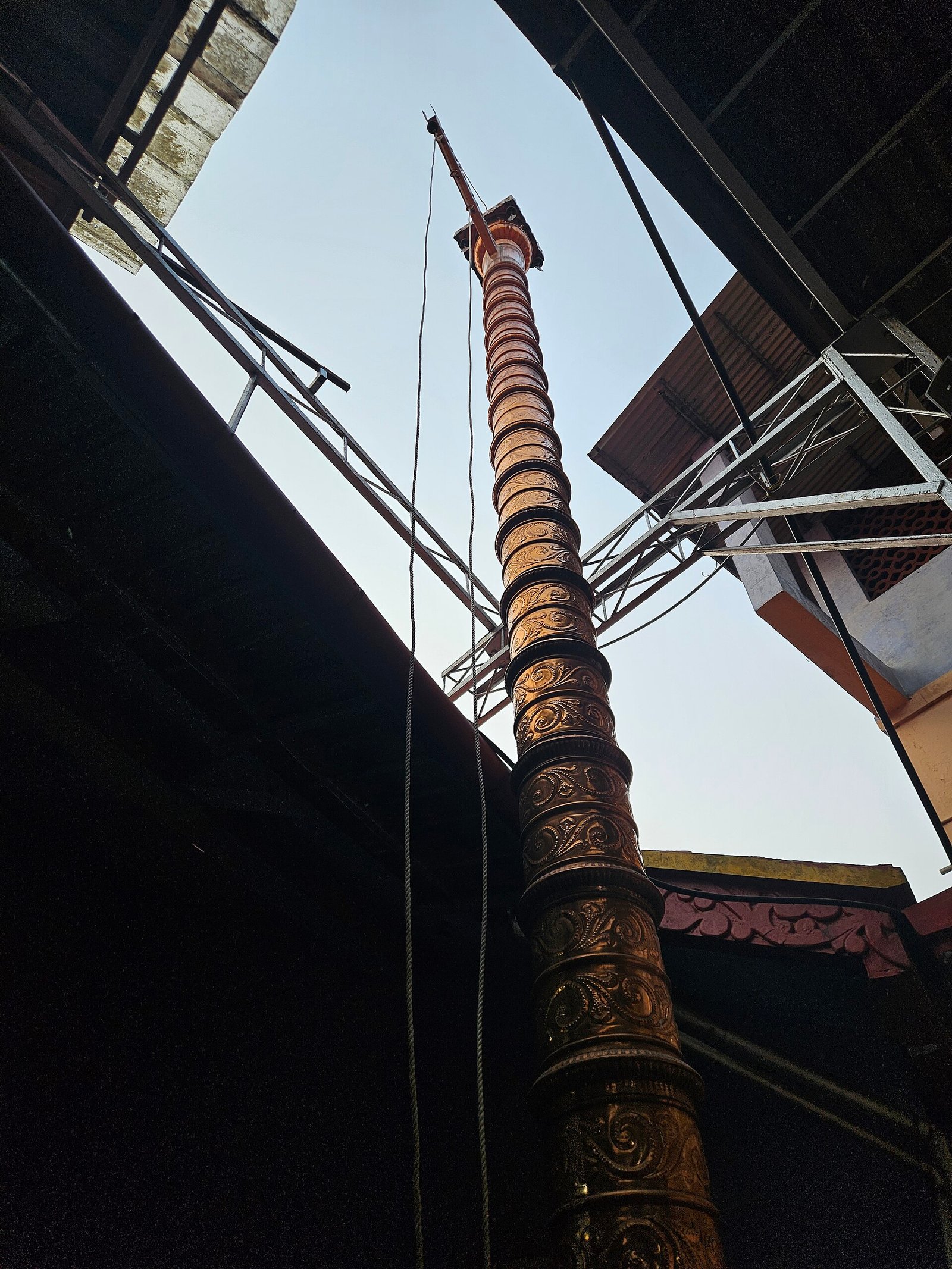
Look up in the compound and you will see the tall, carved flagstaff, the kind of temple detail that tells you this is a working shrine with its own rhythm, not a set. Then give yourself a few minutes by the river before you leave. The daily Theyyam is the reason most people come, but the quiet around the madappura is part of why they remember it.
How to watch Theyyam with respect
Dress as you would for a temple: shoulders and knees covered, and a simple, modest look. Men in a shirt and trousers or a mundu, women in a salwar, saree or anything equally covered, will be fine. Take your shoes off where you see others do it. Keep your voice down. Do not step into the aniyara, the makeup room, to get a behind-the-scenes picture; that space is part of the ritual preparation, not a green room. Do not touch the Theyyam, the costume or the ritual objects, and do not walk between the Theyyam and the shrine to clear a shot.
About photographs: customs vary from shrine to shrine. Some places are relaxed, some are not, and a few moments should never be filmed even if nobody stops you, especially private conversations between the Theyyam and a devotee. Ask first, never use flash, and if someone asks you to put the camera down, put it down at once and without argument. The picture is not the point of your being there. If you come at dawn for Muthappan, the light will be low anyway, and a quiet presence is worth more than a noisy picture.
Best time to see Theyyam in Kannur
For village Theyyam, plan for the season from about mid-October to late May, with December to February the most pleasant months if you are also seeing Bekal Fort, the drive-in beach and the rest of North Malabar. For Muthappan at Parassinikadavu, you are not bound to that season, which is why this shrine is such a gift to travellers whose dates are fixed. Dawn is atmospheric and less hurried than a busy evening, but only if you are willing to start the day very early and to confirm the time beforehand. Summer days get hot; the monsoon is a poor match for long outdoor waits at village shrines, though the daily temple ritual continues.
FAQ
- Is Theyyam a dance performance?
No. Theyyam is a living religious ritual of North Malabar. It can be visually stunning, but it is worship, and the performer is treated as the deity for the duration of the rite.
- Can we see Theyyam every day in Kannur?
You can see Muthappan Theyyam every day at Parassinikadavu. Most other Theyyams are seasonal and happen at village shrines from about mid-October to late May, on dates that belong to each kavu.
- Is Theyyam open to visitors of all faiths?
Yes, visitors of all faiths are generally welcome, especially at the Muthappan shrine, if they dress modestly and behave as guests. Stand where locals stand, and follow any instruction from the shrine.
- Can we take photographs of Theyyam?
Sometimes, but never assume it. Ask first, do not use flash, do not enter the makeup room, and do not photograph or film intimate moments between the Theyyam and devotees. If you are asked to stop, stop.
- What should we wear?
Dress modestly, with shoulders and knees covered, as you would at a temple. You will often be asked to remove shoes, and a light shawl or an extra layer helps at a pre-dawn ritual.
- How early should we arrive for the dawn Muthappan Theyyam?
Arrive with a comfortable margin, not at the last minute. Dawn rituals start early, times can shift, and you will want a quiet place to stand. Confirm the time with the temple the day before.
- Is Theyyam suitable for children and families?
Yes, families do attend, including at village nights. Keep children close, prepare them for drums, fire and crowds, and be ready to step back if a ritual becomes intense. It is not a children’s show, but it is part of ordinary local life.
Final Thoughts
Theyyam is the reason I would send a friend all the way to Kannur even if they had no interest in beaches. The costume is only the door. Behind it is a relationship between a village and its gods that is still alive, still stubborn, and still willing, at its best shrines, to let a stranger stand at the edge and watch. See the daily Muthappan if your dates are tight, and see a night at a kavu if you can; the two together tell the story properly. Did a particular Theyyam stay with you, or was it the drums at dawn? Tell me in the comments. And if you are building a North Malabar list, read my top 10 places to visit in North Malabar and my guide to Bekal Fort, or look further south along the Indian coast with my top 10 in Pondicherry, Auroville and Mahabalipuram.
If Theyyam is the reason you want to come to Kannur, I have already done the planning in my 8-day North Malabar itinerary, built around Theyyam, the beaches and the forts of Kannur, Thalassery and Bekal. You can just use it for the days you have, book from its links and go, with no planning worries. If you want a custom version for your own dates, CLICK HERE to start on the trip form.
I plan the route. I don’t book the ferry, the stay, or the tickets. A custom plan is Rs. 200 per travel day. Fill the trip form, pay online, and I’ll send you the plan.